
Someone I know spent months swiping through galleries and still felt stuck. The real problem was judging what will still read well in two years, not just what looks good on a screen. You will see large realism pieces and pared-down profiles that hold up differently, plus notes on placement pain, longevity, and realistic touch-up timelines to help pick the right bald eagle tattoo for your life and skin.
1. Realistic Bald Eagle in Flight on Full Back

Personal observation lead: I first noticed this on someone at a convention who used negative space between feathers to suggest motion. This back piece is for people who want feather detail and layered saturation that reads from a distance. Tell your artist you want reference photos that show feather flow and eye glare, not just stock eagle images. Expect longer sessions and multiple touch-ups early on to lock saturation. A common mistake is compressing too much detail into a single session. Placement on the back lowers blowout risk compared with ribs but adds longer healing spread across sessions.
2. Neo-Traditional Eagle with American Flag on Upper Arm
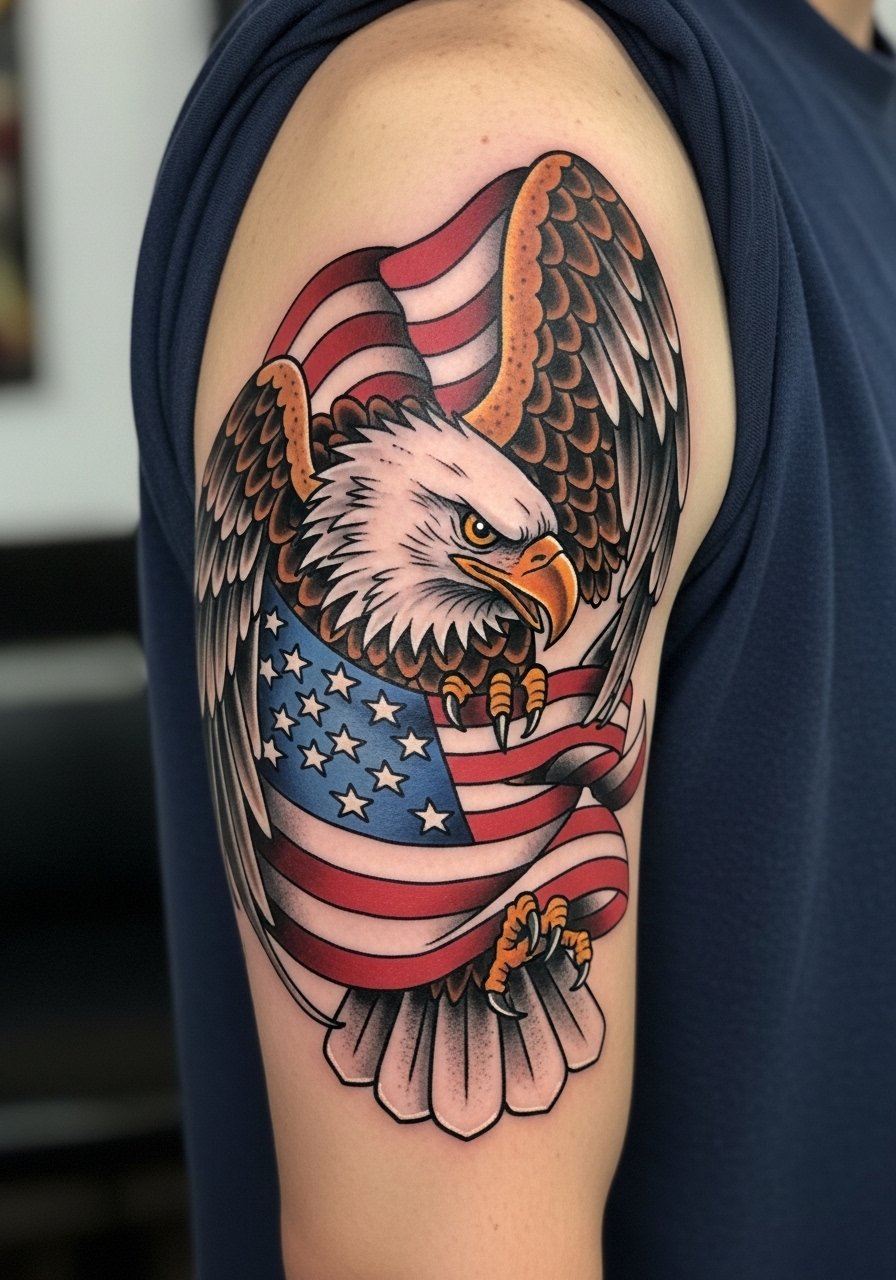
Fair warning: the outer upper arm can ache during longer color fills, but it tolerates saturation well. This style uses bold outlines and saturated fills to keep color pop over time. When you consult, bring flag color references and say you want heavy black outlines around the flag to protect color edges as it fades. The version that ages poorly uses thin outlines and tiny flag details. Expect two to three sessions and plan a touch-up at year two if you wear a lot of sun exposure.
3. Blackwork Eagle Perched on a Branch for Chest

Most people underestimate how high-contrast blackwork reads on darker skin tones. This chest placement demands bold blocks of saturation to keep silhouette clarity. Tell your artist you want solid black masses and negative space around the beak. Artists split on how much stipple shading to use near the sternum. One camp prefers pure block fills for longevity. The other favors fine stipple shading to suggest texture. Ask which approach they use for chest anatomy. Blowout risk is moderate if lines are packed too tightly near the clavicle.
4. Watercolor Eagle Soaring Over Mountains on Forearm

Aging and healing lead: watercolor tattoos often lose contrast faster, and forearm sun exposure accelerates that fade. This version keeps soft washes but adds faint, stable linework at the wing base to hold structure. Tell the artist you want color washes that avoid heavy outlines so the piece reads like a painting. A frequent mistake is asking for pure watercolor with no anchor lines. Expect touch-ups at year two to restore vibrancy. Forearm placement is forgiving for touch-ups, and you can keep saturation longer with regular sunscreen.
5. Geometric Eagle Head Profile on Shoulder

The biggest mistake with geometric heads is making them too small. Lines need breathing room or they merge. This shoulder placement gives enough canvas for clean linework and dot work highlights. Tell your artist you want consistent line weight and mockups showing how geometry aligns with shoulder curve. At six months the angles will look sharp if spacing is correct. Expect a single session for a medium piece and a touch-up in year two to sharpen any minor line settling.
6. Tribal Eagle with Native Patterns on Thigh

Consultation lead: when you bring tribal patterns, say which cultural elements matter to you and ask about respectful adaptation. This style favors thick linework and rhythm that ages well, especially on the thigh where skin shifts less. A common error is borrowing sacred motifs without context. Many people choose a stylized nod rather than a direct replication. Thigh placement is lower on the pain chart and keeps blackwork saturated longer, with touch-ups usually after a few years if needed.
7. Micro-Realism Eagle Eye and Beak on Wrist

Mistake lead: people often ask for too much fine detail in a tiny space, which leads to early blurring. For the wrist, a slightly larger scale keeps the micro-realism readable. Tell your artist you want the eye to be the focal point and to leave margin around it. Expect a single session that feels sharp under the needle because the wrist is bony. Blowout risk increases if the artist packs too many tiny dots too deep. Realistic touch-ups at year one refresh contrast and eye catch.
8. Black and Gray Eagle with Distressed Flag Across Chest

Visual impact lead: layered black and gray realism reads strongly across the chest and keeps storytelling intact as it ages. Ask for gradual shading transitions and mention you want the flag to look worn, not muddy. A version that ages poorly uses flat gray blocks without varied saturation. Expect multiple sessions to build depth and a touch-up around year three for midtone refresh. Chest skin is stable for shading but avoid overly tight stipple near the sternum to limit blowout.
9. Traditional American Eagle in Flight on Upper Arm

Personal observation lead: classic traditional pieces age predictably when outlines are thick and color blocks are simple. For the upper arm, demand bold black linework around wing feathers and flat color fills. The mistake I see most is requesting tiny feather details that today's bold traditional style does not need. Sessions are shorter because color fields are straightforward. Expect a touch-up at year two for edge re-saturation if you spend a lot of time outdoors.
10. Minimalist Eagle Silhouette with Stars on Collarbone
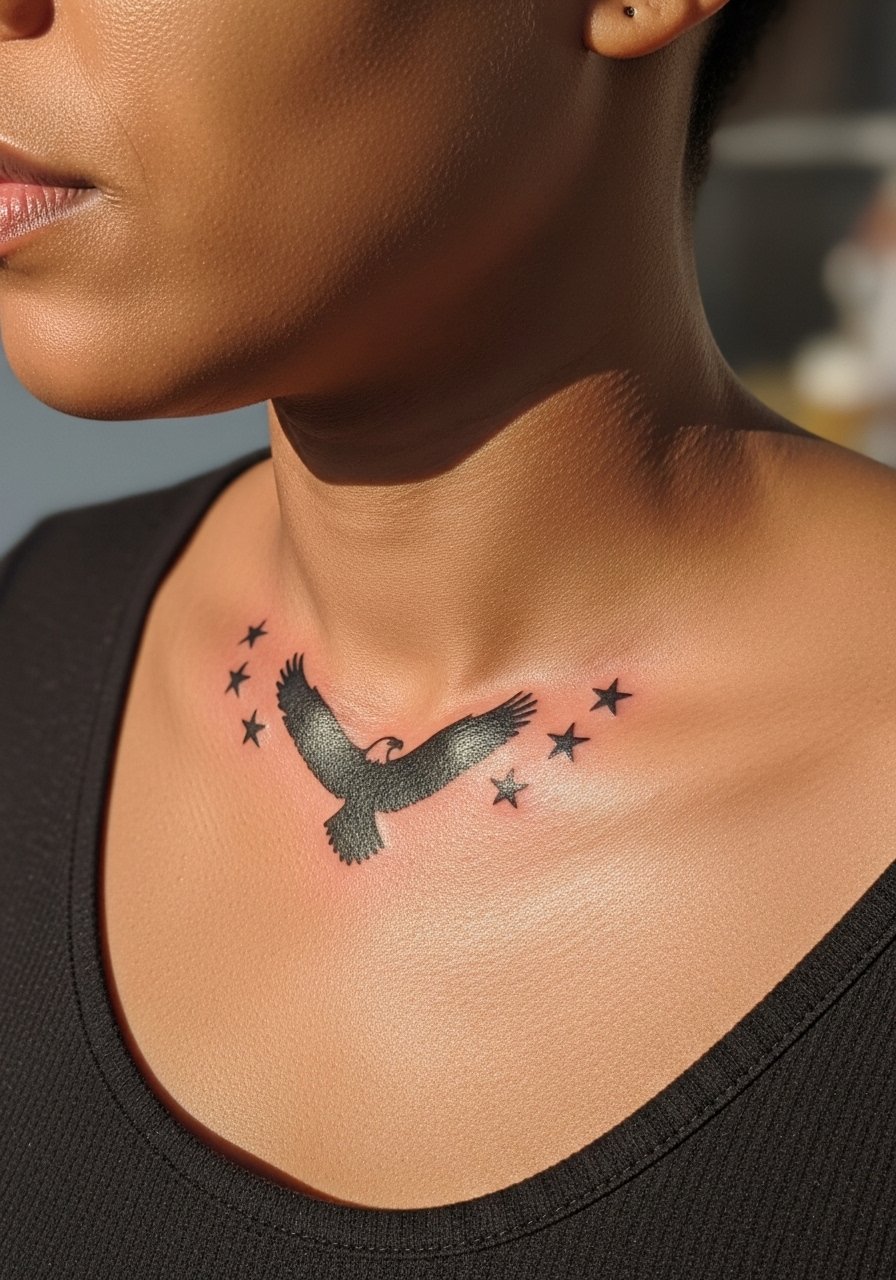
Pain warning lead: collarbone placement can be sharp to the touch, but minimalists heal quickly. Keep silhouettes bold enough so the shape does not feather into indistinctness. Tell your artist you want a solid silhouette and simple stars spaced evenly. A common mistake is choosing a silhouette too narrow, which invites early blurring. Expect a single quick session and a touch-up opportunity if edges soften after two years. Also consider how jewelry and clothing will interact with the area while it heals.
11. Neo-Traditional Eagle with Skull and Flowers on Back Panel
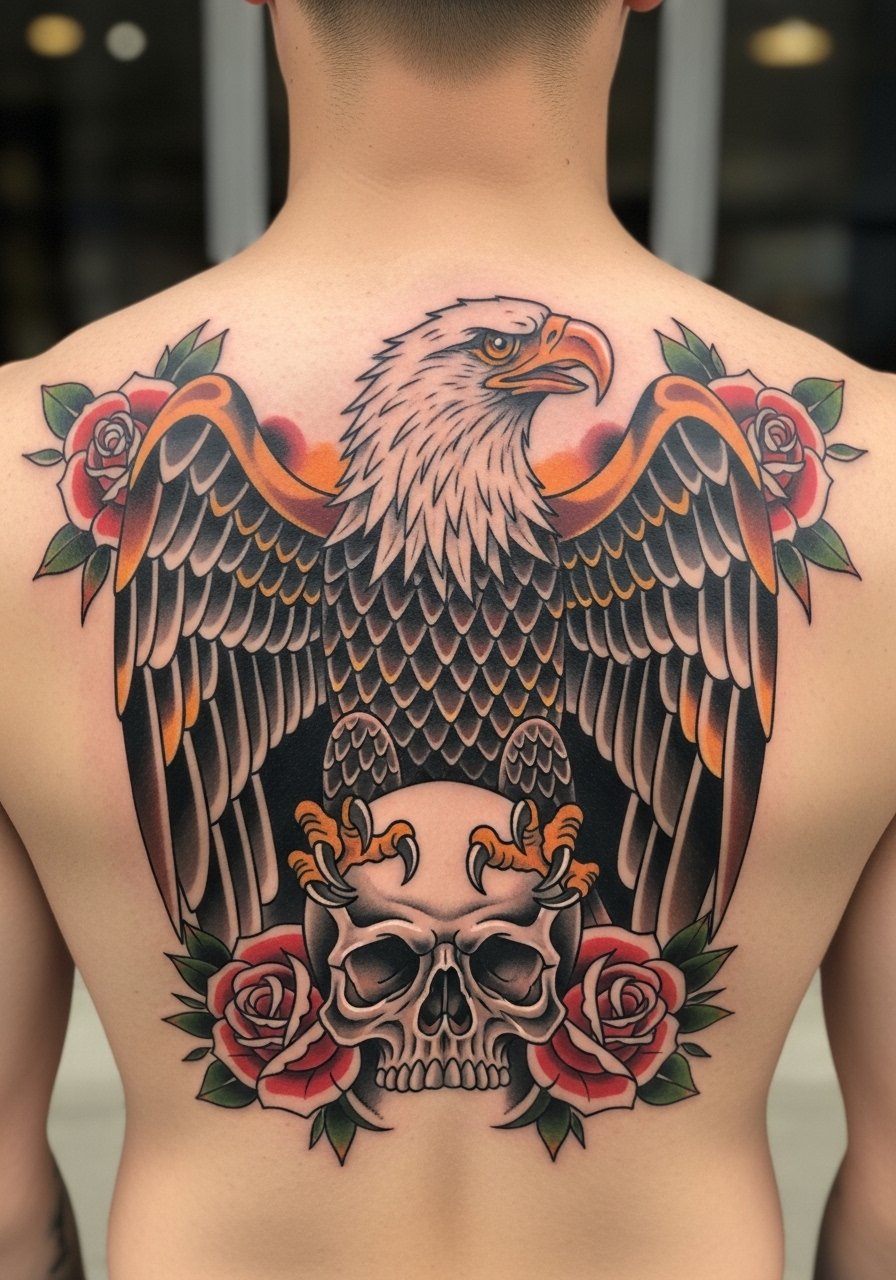
Aging/healing lead: floral pigments and saturated reds often shift faster than deep blacks. For a back panel, ask for deep black anchors around skull edges to protect color boundaries. The flawed version skips those anchors and ends up with muddy overlap after a few years. Plan three sessions so your artist can layer color intelligently. Back panels are forgiving for large detail, but expect touch-ups for red and yellow tones sooner than for blues and blacks.
12. Realism Eagle Clutching a Shield as Sleeve

Consultation lead: sleeves require session planning and coherent transitions. Ask how the eagle will flow with arm musculature and if the shield will bridge elbow folds. A mistake is treating the sleeve as separate flash pieces. Discuss sequencing and touch-up windows. Realism needs layered saturation and multiple sessions. Expect annual touch-ups early on as your skin settles. Note that inner arm sections near the elbow can be higher risk for early fading due to friction.
13. Watercolor Eagle with Mountain Scene on Calf
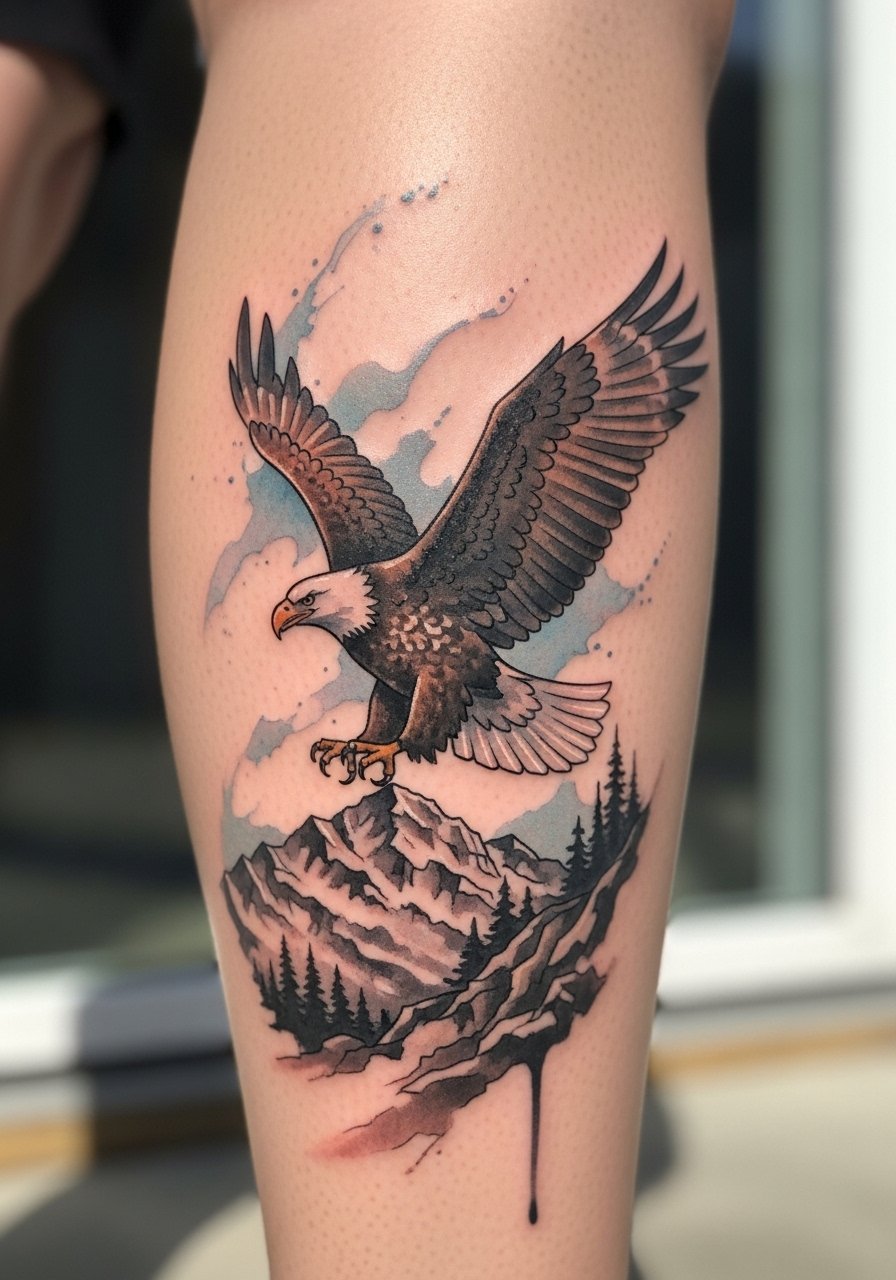
Visual impact lead: calves offer vertical space for scenic watercolor compositions. Since watercolor fades faster, anchor washes with thin, stable contour lines around key elements like talons and cliff edges. People often skip anchors and then lose scene definition. Calf placement handles touch-ups well and is easy to cover during healing. Expect three sessions and to plan for a re-saturation at year two if the piece is exposed to sun frequently.
14. Geometric Eagle Chest Patch with Dot Work Halo
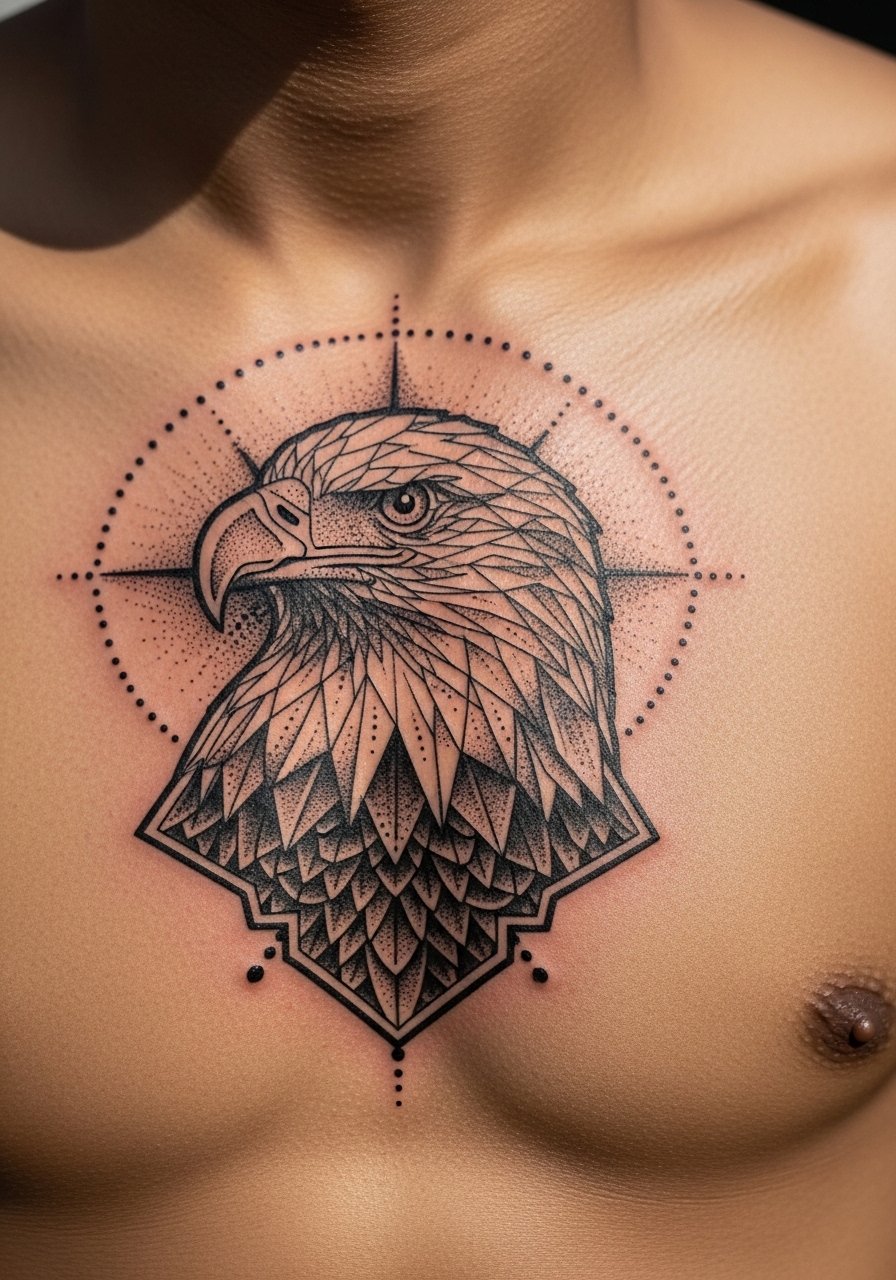
Mistake lead: packing too many concentric geometric rings creates muddiness across the chest. Keep spacing intentional and ask for line weight samples that show how geometry sits on your pectoral curve. Dot work halos age well if dots are spaced to avoid merging. Chest placement allows for dramatic negative space but requires an artist experienced with stipple shading. Plan a touch-up after two years to redefine any lines that settle flatter than expected.
15. Tribal-Infused Eagle with Modern Lines on Ribcage

Pain warning lead: ribs are higher on the pain chart, so expect a tougher session. Artists split on fine line use here. One camp says the stretch and breathing blur thin lines quickly. The other says proper needle depth and spacing will keep lines crisp. Name both camps and ask your artist which approach they use for ribs. If you want tribal influence, pick larger shapes to resist blowout. Plan for touch-ups year one and year three depending on settling.
16. Micro-Realism Talon Grasp on Ankle

Personal observation lead: ankles show detail beautifully when proportion is respected. For talon studies, tell the artist you want clear negative space between talon pads and skin. A frequent error is compressing claws so they read as a blob later. Ankle skin can shift and bruise, so expect a slightly tender session and consider a touch-up within the first year if lines soften.
17. Blackwork Eagle Head in Profile on Upper Chest

Controversy lead: some purists argue blackwork loses facial nuance while others say silhouette strength matters more. Name both camps. One group wants dense black to age well. The other group wants careful negative carving for facial detail. Decide which outcome you prefer and ask for healed photos of similar placements. Upper chest keeps bold black clear longer than thin gray shading, and touch-ups can be scheduled at year three for any midtone loss.
18. Minimalist Eagle Outline Behind Ear

Mistake lead: the common error is choosing lines that are too thin behind the ear where skin movement and hair growth can distort edges. If you want a discreet outline, ask for slightly thicker linework and a simple profile. Behind-ear placement is delicate and needs an artist comfortable with tiny areas. Expect a very short session and a small touch-up if the line softens after several months.
19. Neo-Traditional Eagle with Compass and Clock on Forearm

Personal observation lead: integrating compasses or clocks gives narrative weight and makes the piece uniquely yours. Tell the artist where you want focal points and how the eagle should interact with the compass. A mistake is cramming too many small timepiece details that blur later. Forearm proportions allow for readable instruments and the eagle to wrap the scene. Plan for two to three sessions and a touch-up for small numbered elements if they start to soften.
20. Watercolor Eagle with Rugged Landscape on Side Torso

Aging/healing lead: side torso skins stretch more with movement, so watercolor washes need anchors to avoid bleeding into seams. Tell your artist you want thin contour lines around the mountain ridge to preserve silhouette. A frequent mistake is full watercolor without anchors which blurs after weight changes. Side torso pieces heal over multiple sessions and might need re-saturation when your skin settles.
21. Geometric Eagle with Stipple Shading on Outer Thigh

Consultation lead: for stipple shading, ask to see healed dot work examples on similar skin tones. Dot density determines how long the gradient holds before merging. Thigh placement gives room for geometry and dot work to breathe. A common error is asking for too tight dot spacing, which leads to faster tonal flattening. Expect two sessions and a touch-up in years two to four depending on how your skin responds.
22. Traditional Eagle Head with Banner on Bicep
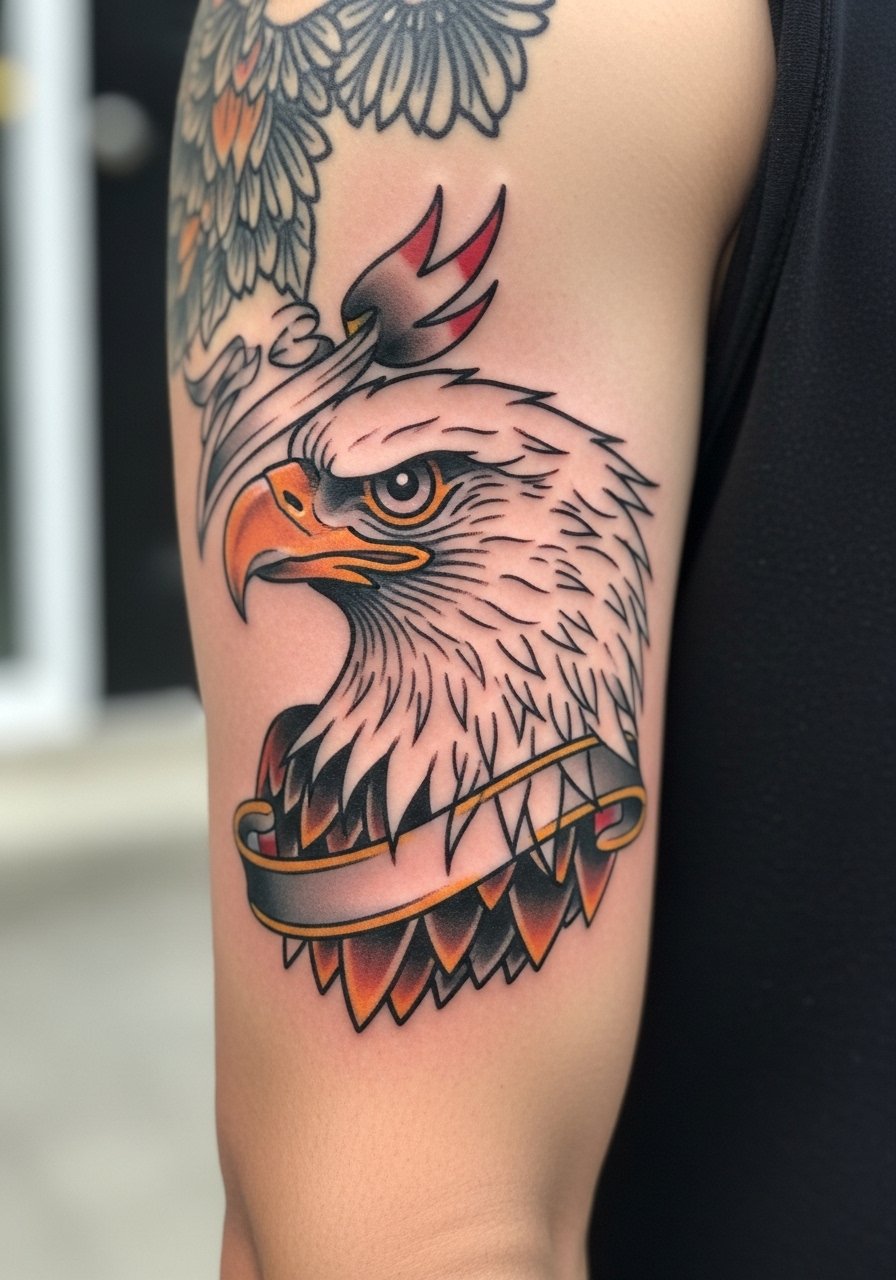
Visual impact lead: biceps display traditional work well since the curvature adds dynamic view. Tell your artist the banner text you want and ask for solid black borders around the letters. The mistake I see is thin banner scripts that blur at edges. Sessions are moderate and touch-ups in year two keep the banner legible. This placement handles sun exposure moderately well if you protect it outdoors.
23. Micro-Realism Eagle Eye with Roman Numerals on Wrist

Mistake lead: tiny lettering near micro-realism elements can look crisp initially and then soften. When requesting text, specify exact numerals and font weight. For this design, say "XII.XXV.MCMXCIV in thin serif font" so mockups show scale. Wrist placement is sensitive but yields a sharp personal statement. Expect one session and a quick touch-up if the numerals lose edge.
24. Black and Gray Eagle Portrait over Heart Area
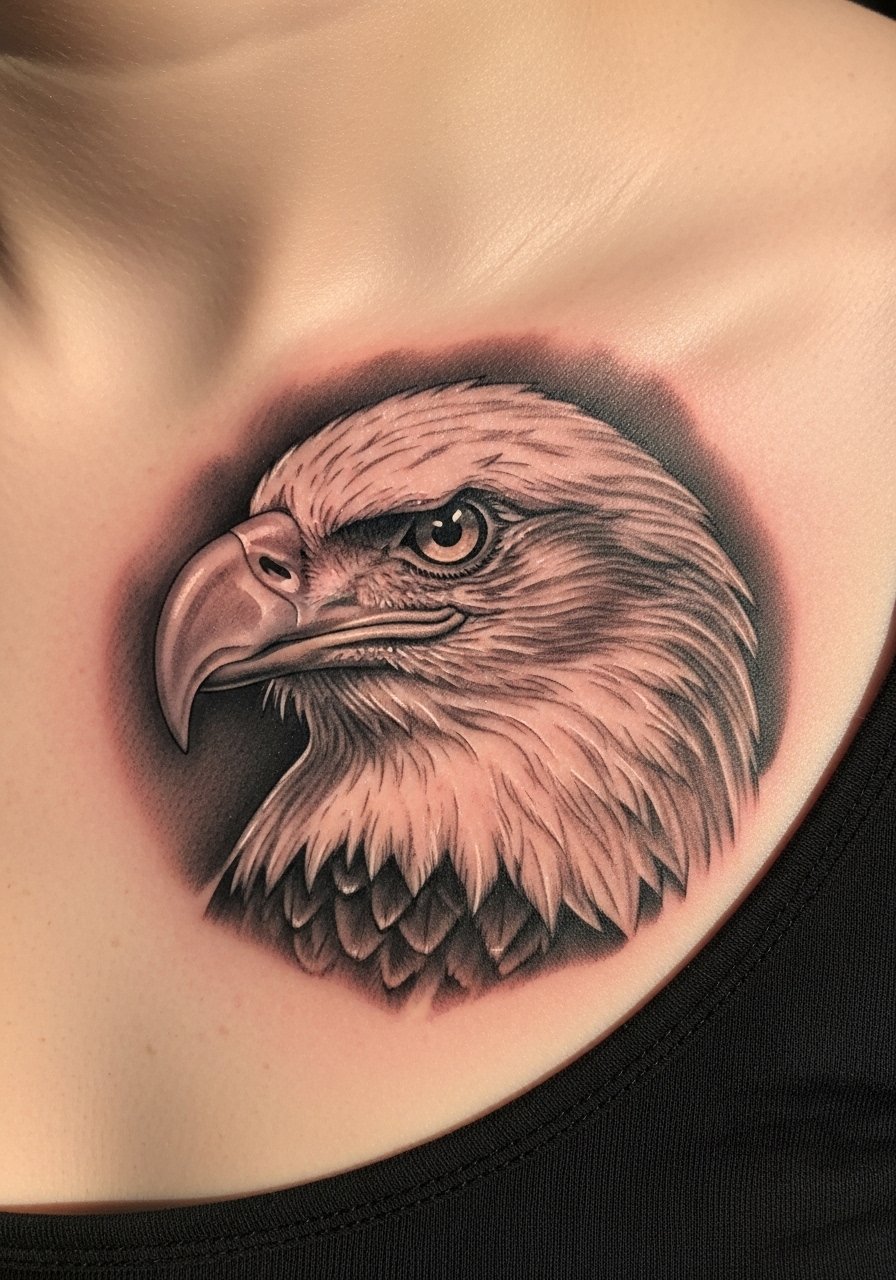
Personal observation lead: portraits over the sternum read as intimate pieces, so plan for an artist comfortable with midtone realism. Tell them you want eye catch and a soft highlight on the beak. A mistake is overworking contrast and losing feather texture. Sternum work can be more painful and may require split sessions. Expect touch-ups in year two for midtone refresh if you expose the chest frequently to sun.
25. Linework Eagle Silhouette Down the Spine

Consultation lead: spine placement requires careful line placement to follow vertebrae. When you sit with your artist, request mockups aligned to your posture. The biggest mistake is too-thin lines that migrate on this mobile area. Spine work feels intense due to proximity to bone, and touch-ups may be needed sooner if lines thin. Choose slightly bolder fine line weight to preserve silhouette over time.
Tattoo Prep and Aftercare Essentials
Fragrance-free gentle foaming cleanser for tattooed skin. Use this in the first week to remove blood and plasma without stripping ink. Clean gently with lukewarm water and pat dry, do not rub.
Lightweight fragrance-free healing balm. Apply a thin layer after cleaning to keep the area hydrated while avoiding pore clogging.
Medical-grade second skin bandage, 6-inch roll. Useful for large back or chest sessions to protect fresh ink during the first 24 to 48 hours.
Non-comedogenic broad-spectrum sunscreen SPF 50. Long-term color protection depends on diligent sunscreen use once healed.
Lightweight silicone-based scar gel alternative. Helps flatten raised lines after healing if your skin scars.
Breathable tattoo-specific aftercare ointment (alternative to mainstream). Pick an ointment labeled fragrance-free and non-greasy for daytime use.
Medical adhesive bandages for small spots. Keep handy for small touch-up healing areas or blisters.
Aquaphor Healing Ointment. A single mainstream reference that absorbs well for some skin types. Use sparingly and discuss with your artist if you need an occlusive for overnight care.
Every tattoo is different. Always follow your artist's specific aftercare instructions. Consult a dermatologist if you have skin concerns or unusual healing issues.
Frequently Asked Questions
Q: Will a watercolor bald eagle fade faster than a blackwork piece on the forearm?
A: From what I've observed, watercolor washes lose contrast sooner than dense blackwork, especially on sun-exposed forearms. If you love watercolor, ask your artist to add thin anchor lines around focal elements and plan on touch-ups every one to three years depending on exposure.
Q: If I want fine line geometry on the ribs, what should I ask the artist about long-term results?
A: Ask whether they frequently do fine line work on ribs and to show healed photos for that placement. There are two camps. One says ribs stretch and blur thin lines. The other says with correct needle depth and spacing it holds up. Your artist's portfolio will tell you which approach they favor.
Q: How often do realism full-back eagles need touch-ups in the first five years?
A: Realism usually needs an initial touch-up within the first year as layers settle, then occasional touch-ups around years three and five depending on pigment density and sun exposure. Planning sessions upfront helps avoid overworking fresh skin.
Q: Do compass or clock elements require different care than feathered sections?
A: Instruments with small numbers and thin ticks need sharper preservation. Ask for slightly bolder numerals and discuss touch-up timing for tiny elements. Feathers take layered shading, so their refresh schedule may differ from the instruments.
Q: Are there placement-specific pain differences for these eagle designs I should prepare for?
A: Yes. Ribs and spine are on the higher end of pain. Collarbone and ankle can be sharp. Outer thigh, upper arm, and back are generally more comfortable. Expect shorter sessions on painful areas or split the work across visits.
Q: Where should I look to find artists who specialize in realism or neo-traditional eagle work?
A: Search style-specific hashtags like #realismeagle or #neotraditionaleagle and check location tags for "[city] neo-traditional tattoo studio". Tattoo directories and community forums often have galleries and healed photos you can study before booking.
