
I spent months sketching zodiac glyphs, staring at healed photos, and asking artists which astro motifs really hold up. The trick wasn’t finding pretty images — it was picking styles that age well and feel personal. These 27 astrology tattoos marry symbolism with real-life wear: fine line glyphs that soften, bold constellations that keep their shape, and celestial pieces that still read after sun and time.
Quick context: I focused on astrology tattoos across fine line, dotwork, neo‑traditional, and watercolor vibes. These ideas work for hidden spots (rib, thigh) and high-visibility placements (collarbone, forearm). I leaned into trends artists mention most: minimalist glyphs, constellation dotwork, and meaningful birth-chart pieces that stay relevant.
Fine Line Zodiac Glyph Row on Inner Wrist
Style/Technique: Fine Line / Minimalist
Pain Level: Low (2-3/10)
Session Time: 30–60 minutes
Best For: First tattoo, stealthy daily reminder
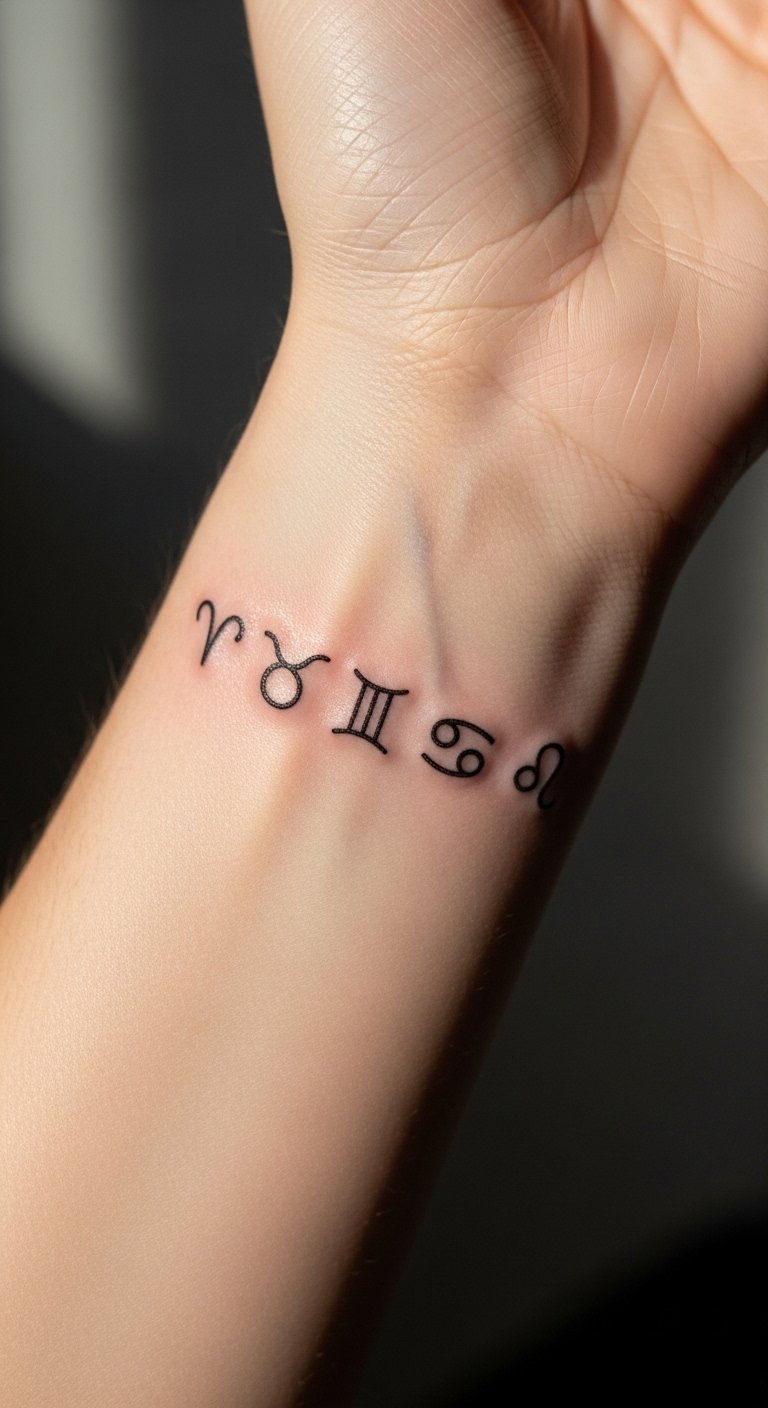
I love this for how readable and tiny it can be without losing meaning. Glyph rows are delicate—artists use single-needle or tight 3RL work—so find someone experienced with fine-line or micro-realism. Expect mild soreness and quick surface healing (about 1–2 weeks), but know fine lines can blur if ink sits too shallow or the lines are spaced too tightly. A common mistake is shrinking glyphs down so small the lines fuse as they settle; ask your artist about slight spacing and slightly heavier line weight for longevity. Use sunscreen on the area long-term and opt for fragrance-free lotion during healing. Related terms: minimalist, fine line, zodiac glyph.
Constellation Scatter Across Collarbone
Style/Technique: Fine Line / Dotwork
Pain Level: Medium (3-5/10)
Session Time: 1–2 hours
Best For: Visible, elegant pieces that pair with jewelry
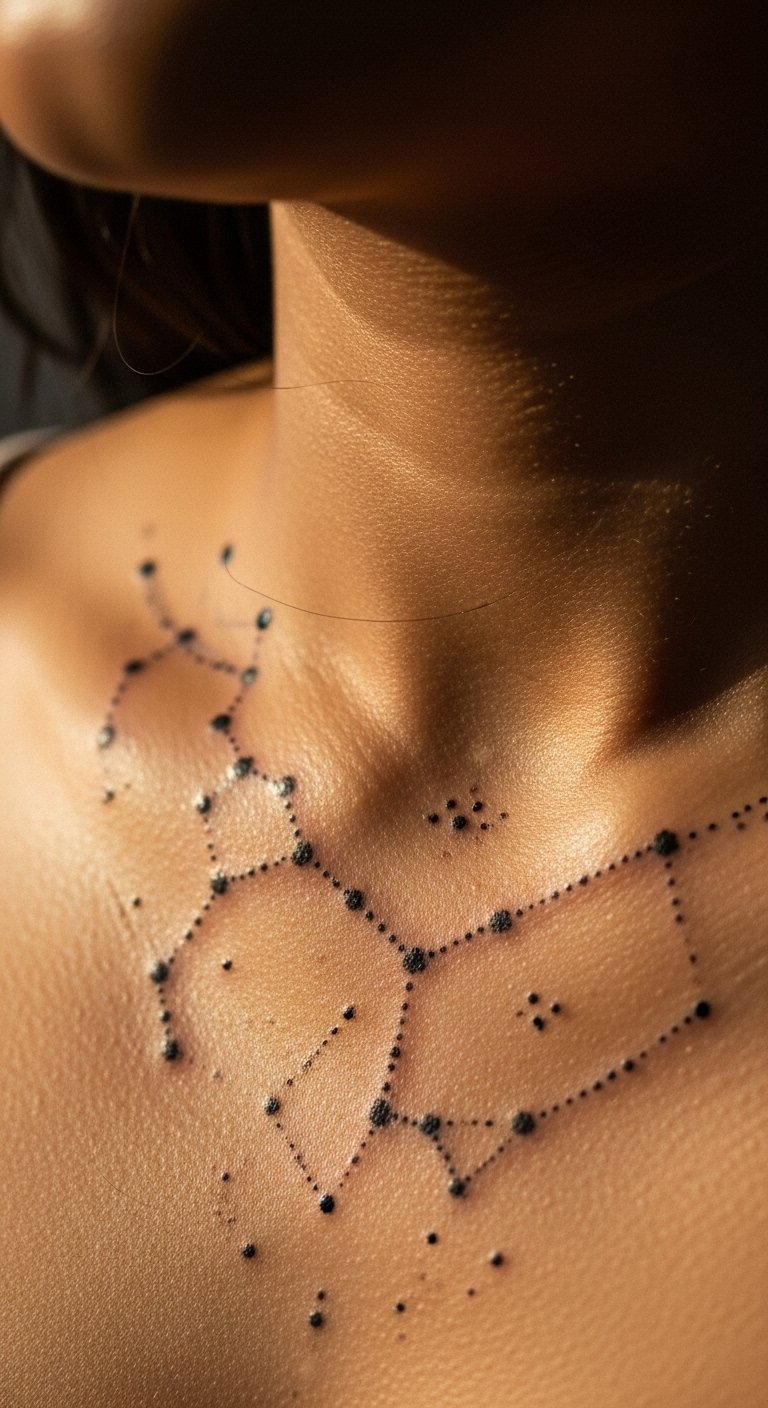
Constellation scatters read like jewelry and let you place stars around natural contours. I saw this pop up as a subtle way to wear your sign without a literal symbol. Dotwork lets you simulate star brightness; thin connecting lines keep the look airy. Collarbones take a bit more sting than the forearm, and healing needs gentle movement care—sleeping position matters. Expect the dots to remain readable; tiny linework may soften over time, so artists often suggest slightly bolder star dots than you think you need. Avoid over-cluttering; negative space is what makes this style feel cosmic. Related: dotwork, constellation, minimalist.
Lunar Phase Spine Column
Style/Technique: Blackwork / Fine Line
Pain Level: High (6-8/10)
Session Time: 1–3 hours (may be split)
Best For: Statement piece, spiritual symbolism
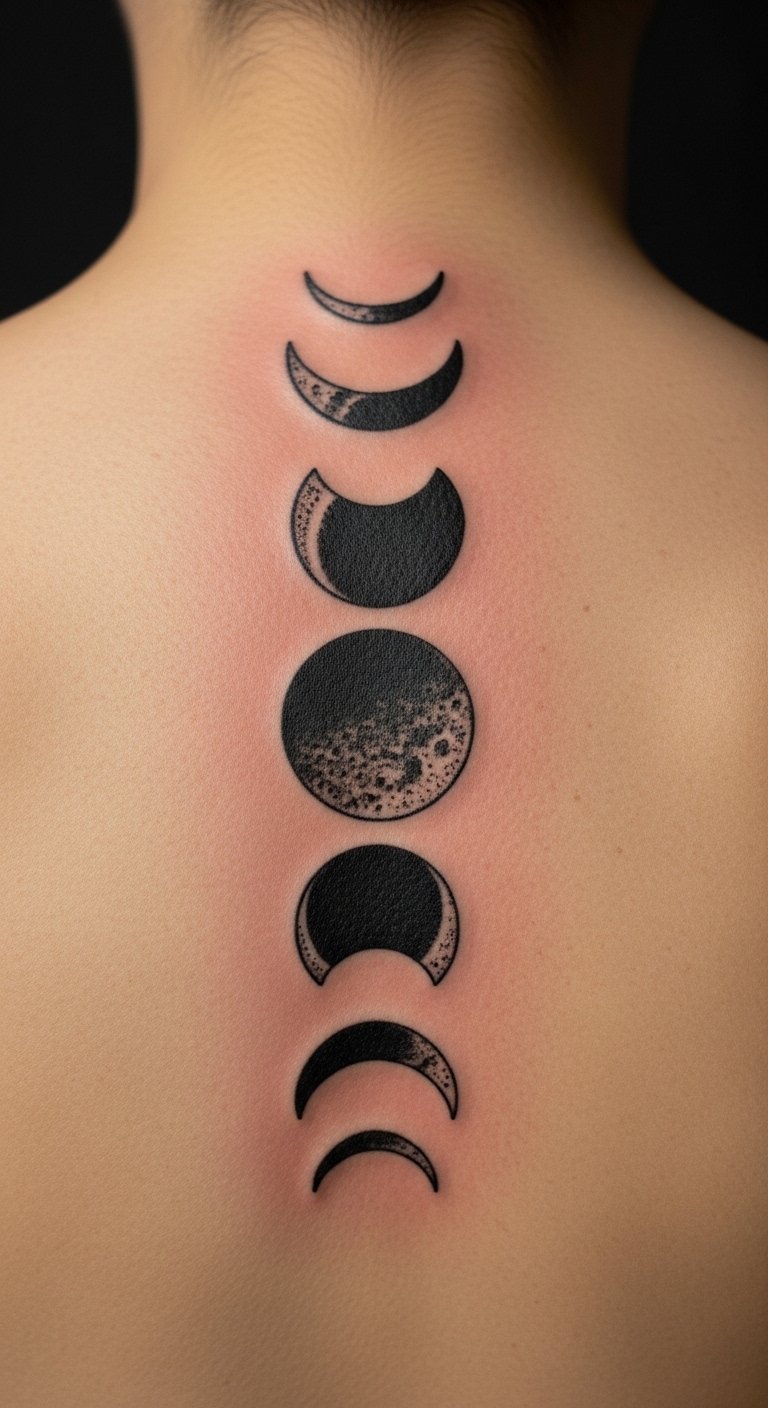
Moon-phase columns look great down the spine because the vertical space matches the cyclic idea. Expect stronger pain—spine/vertebrae areas are sensitive—so plan accordingly. Healing takes careful sleeping and minimal friction from clothing. Blackwork moons hold up well; solid blacks blur less surprisingly, but tiny lunar details can soften, so ask for crisp negative-space crescent shapes rather than ultra-thin lines. One frequent misstep is placing the sequence too close to the spine’s bony ridge; a slightly offset placement looks better and hurts a touch less. This style ages predictably if filled blacks are used. Related: lunar phases, blackwork, celestial.
Sun And Moon Sternum Mandala
Style/Technique: Neo‑Traditional / Micro‑Realism
Pain Level: High (7-9/10)
Session Time: 2–4 hours (may be multiple sessions)
Best For: Bold centerpieces, intimate statements
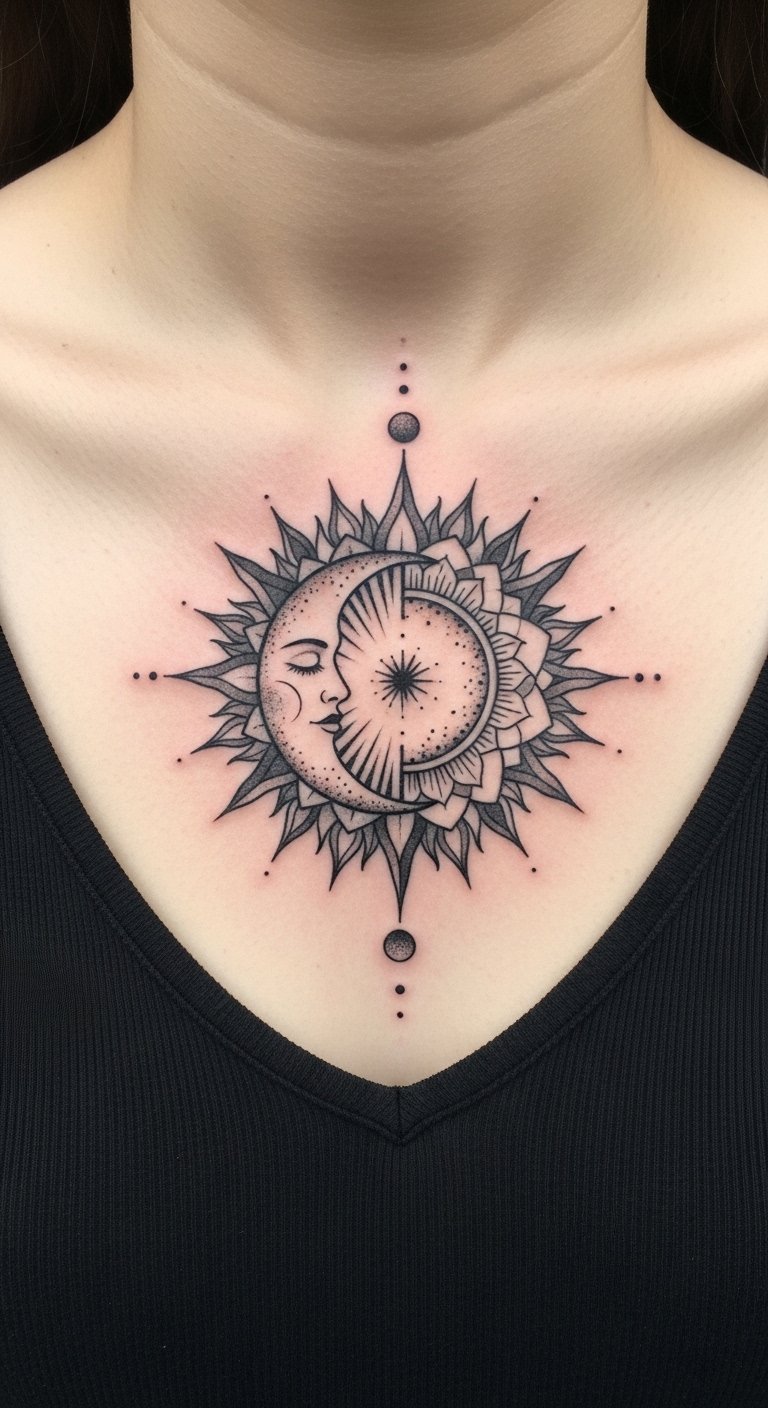
Sternum mandalas centered on a sun/moon motif read like a personal talisman. The sternum is a high-pain area, particularly near the bone, but it’s striking and private when you want it to be. Neo‑traditional shading gives the sun warmth and the moon a soft glow; micro‑realism details can make facial moon features readable. Expect several weeks for surface healing and a few months for full settling. Avoid tiny filigree too close to the bone—those fine details blur fastest. Artists skilled in symmetrical, geometric work are ideal; ask to see healed sternum mandala examples. Related: mandala, neo-traditional, micro-realism.
Birth Chart Wheel On Upper Back
Style/Technique: Illustrative / Dotwork
Pain Level: Medium (4-6/10)
Session Time: Multiple sessions, 3–6+ hours total
Best For: Astrology collectors, statement pieces that can be covered
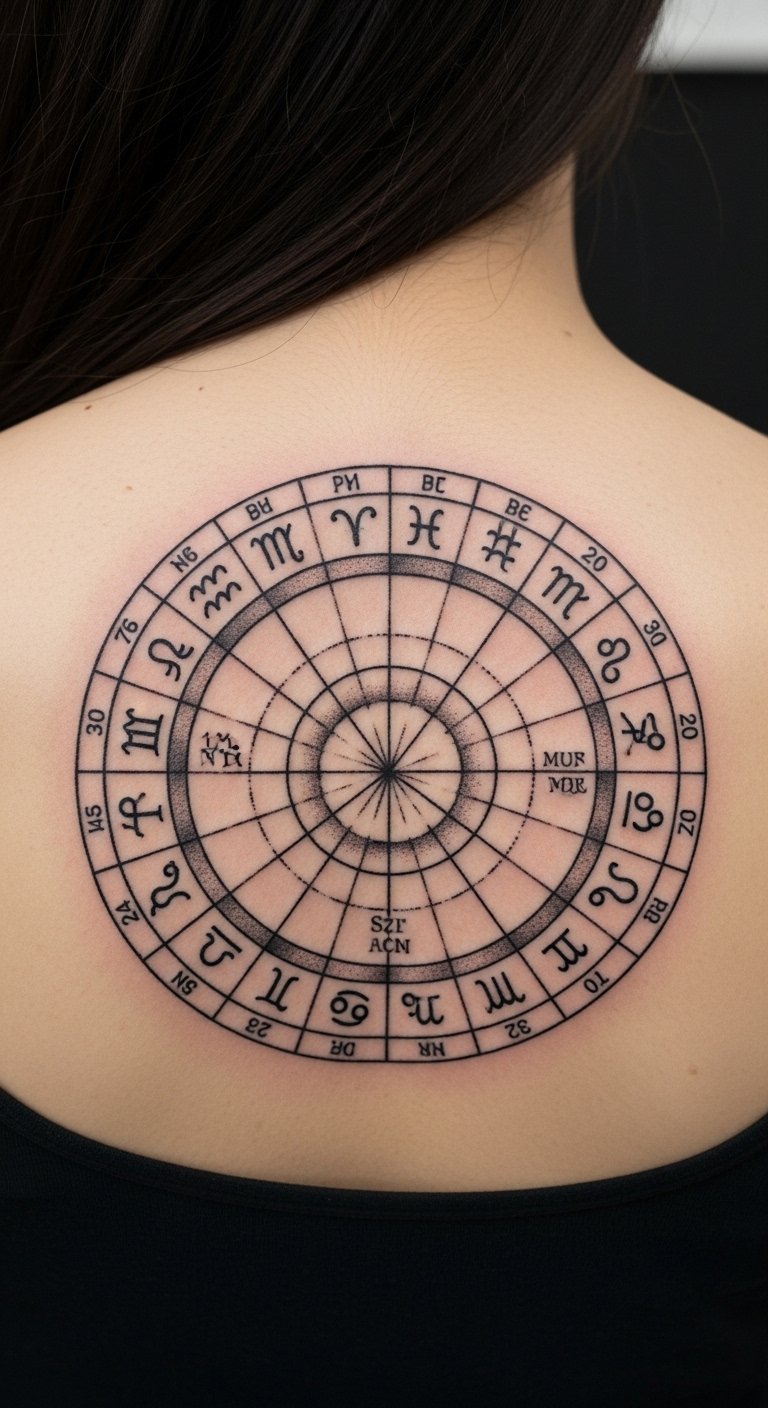
The natal chart wheel is the most literal astrology tattoo you can get: placements, houses, and glyphs in one circular piece. I found artists treat these like maps—clarity is everything—so give space to each house and avoid cramming glyphs. Upper back has moderate pain and is great for a larger, coverable canvas. Healed photos show that thick, consistent line weight for the rim and slightly bolder glyphs keeps the wheel legible over time. Common errors include miniaturizing too many details; a simplified wheel with key placements called out ages much better than a tiny technical chart. Related: natal chart, zodiac wheel, dotwork.
Star Map Of Your Birth Night On Ribcage
Style/Technique: Micro‑Realism / Fine Line
Pain Level: High (8-9/10)
Session Time: 2–4 hours
Best For: Intimate, highly personal tattoos

A custom star map of your birth night reads like a tiny universe you can fold under clothing. Ribs are one of the higher-pain placements but the canvas allows for precise, beautiful work. Micro‑realism captures exact star positions; artists often sketch the map from software and translate it into dotwork and tiny connecting lines. Expect significant aftercare because rubbing from clothing and breathing affects healing. Avoid making star dots too tiny—artists recommend slightly bigger dots for longevity. This piece is deeply personal and often brings tears when shown. Related: star map, micro-realism, constellation.
Planetary Sigils Along Collarbone
Style/Technique: Minimalist / Fine Line
Pain Level: Medium (3-5/10)
Session Time: 30–90 minutes
Best For: Symbolic, subtle astrology jewelry
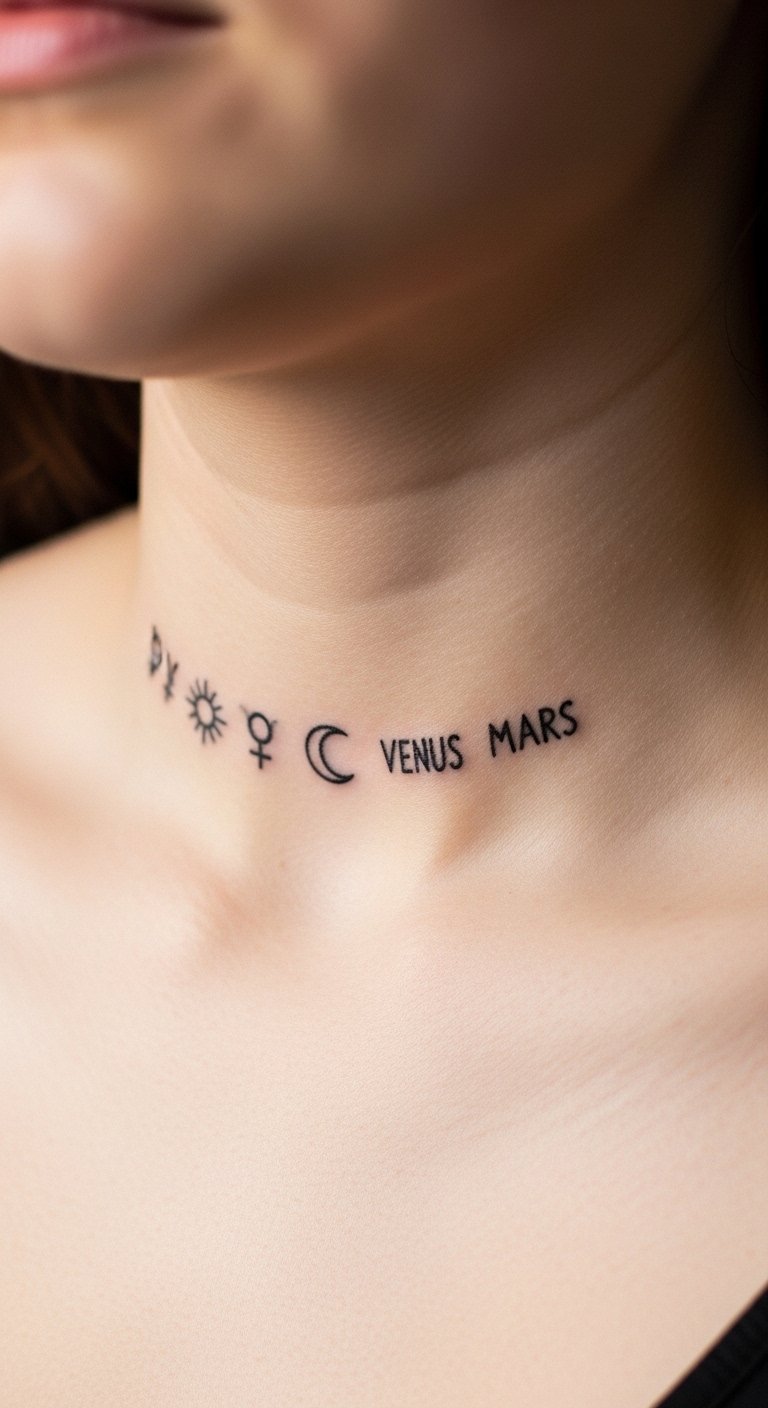
Line up planetary sigils as a literal graph of what matters to you—sun, moon, Venus for love, Mars for drive. Collarbone placements are visible and pair nicely with necklaces. Tiny sigils need careful spacing and a slightly stronger line weight than you’d imagine; otherwise, they can blur together as skin settles. Pain is manageable but the area’s thinner skin makes the sensation sharper than forearm work. Artists who do crisp iconography and small-scale script translate these symbols cleanly. Avoid overloading with too many sigils; pick the ones that carry real meaning for you. Related: planetary sigil, minimalist, glyph.
Watercolor Galaxy Thigh Piece
Style/Technique: Watercolor / Fine Line Accents
Pain Level: Medium (4-6/10)
Session Time: 2–5 hours
Best For: Statement art that can be shown or covered

Watercolor galaxies read like paintings; the thigh gives room for sprawling color with delicate constellation overlays. I’ve noticed watercolor fades in spots faster than black, so artists mix in fine-line constellations or a black outline to anchor the piece. Thighs are forgiving for pain and heal under clothing—watch friction during the first two weeks. A common mistake is relying solely on watercolor without anchor lines; ask your artist how they plan to balance pigment saturation and black contrast for lifespan. This style feels expressive and otherworldly when healed. Related: watercolor, galaxy, fine line.
Element Symbols Behind Ear
Style/Technique: Minimalist / Single Needle
Pain Level: Low (2-4/10)
Session Time: 15–45 minutes
Best For: Tiny statements, easy to hide
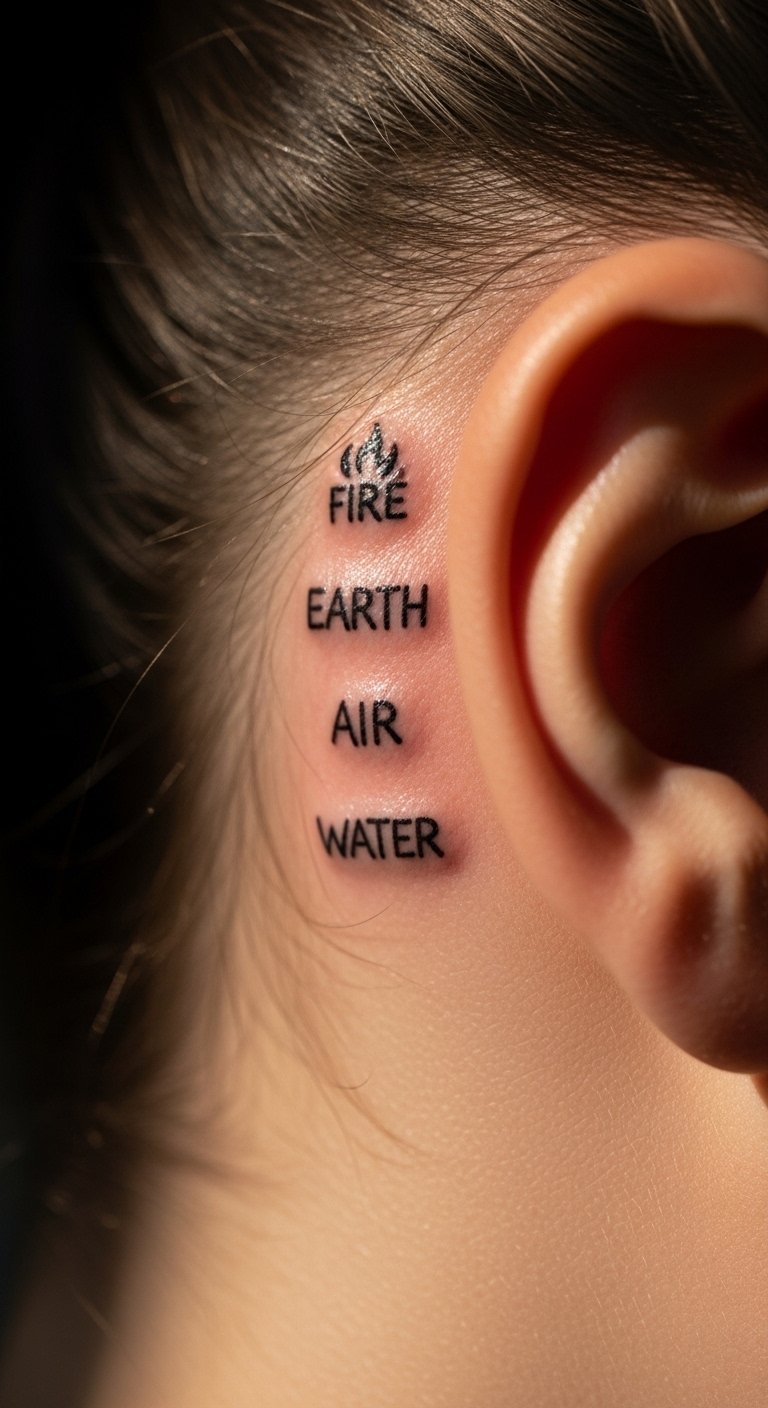
Behind-the-ear element symbols are nearly invisible unless you tuck your hair. They’re great for testing pain tolerance and for small, meaningful ink. The area is bony and can sting; healing is quick but be cautious with earrings or pressure. Single-needle work requires an artist who routinely tattoos tiny icons. The usual mistake is making the glyphs so small they blur into a smudge—scale them slightly larger than you think. Keep in mind hair can irritate the area while healing. Related: element symbols, minimalist, single-needle.
Gemini Mirror Collarbone Twins
Style/Technique: Fine Line / Illustrative
Pain Level: Medium (3-5/10)
Session Time: 1–2 hours
Best For: Symmetry lovers, visible pieces

Mirrored twin figures across the collarbone play into Gemini’s duality and work beautifully with jewelry. Symmetry is the priority—artists often stencil both sides and check placement while you stand. Collarbone bite is noticeable but manageable. The visual impact comes from confident, clean lines; avoid overly fussy detail or the twins will lose identity as the piece ages. Ask about subtle shading to add depth; too much shading on thin lines blurs. This is playful and readable after healing. Related: illustrative, duality, minimalist.
Scorpio Scorpion Wrist Wrap
Style/Technique: Neo‑Traditional / Blackwork
Pain Level: Medium (4-6/10)
Session Time: 1–3 hours
Best For: Statement bands and dynamic wraps

A scorpion wrap uses the wrist’s round shape to create movement; neo‑traditional weight keeps claws distinct and the tail readable. Wrist skin is exposed and moves a lot, so expect changes with time; solid blacks hold up best. Pain is moderate—inner wrist is more sensitive than outer. A common issue is thin tails that spread; request tapered but slightly thicker lines on parts likely to blur. This feels bold and symbolic when healed and is a great way to make a zodiac animal feel like jewelry. Related: neo-traditional, blackwork, wrap.
Sagittarius Archer Shoulder Blade
Style/Technique: Traditional / Illustrative
Pain Level: Medium (4/10)
Session Time: 1–2 hours
Best For: Back artwork that peeks from clothing
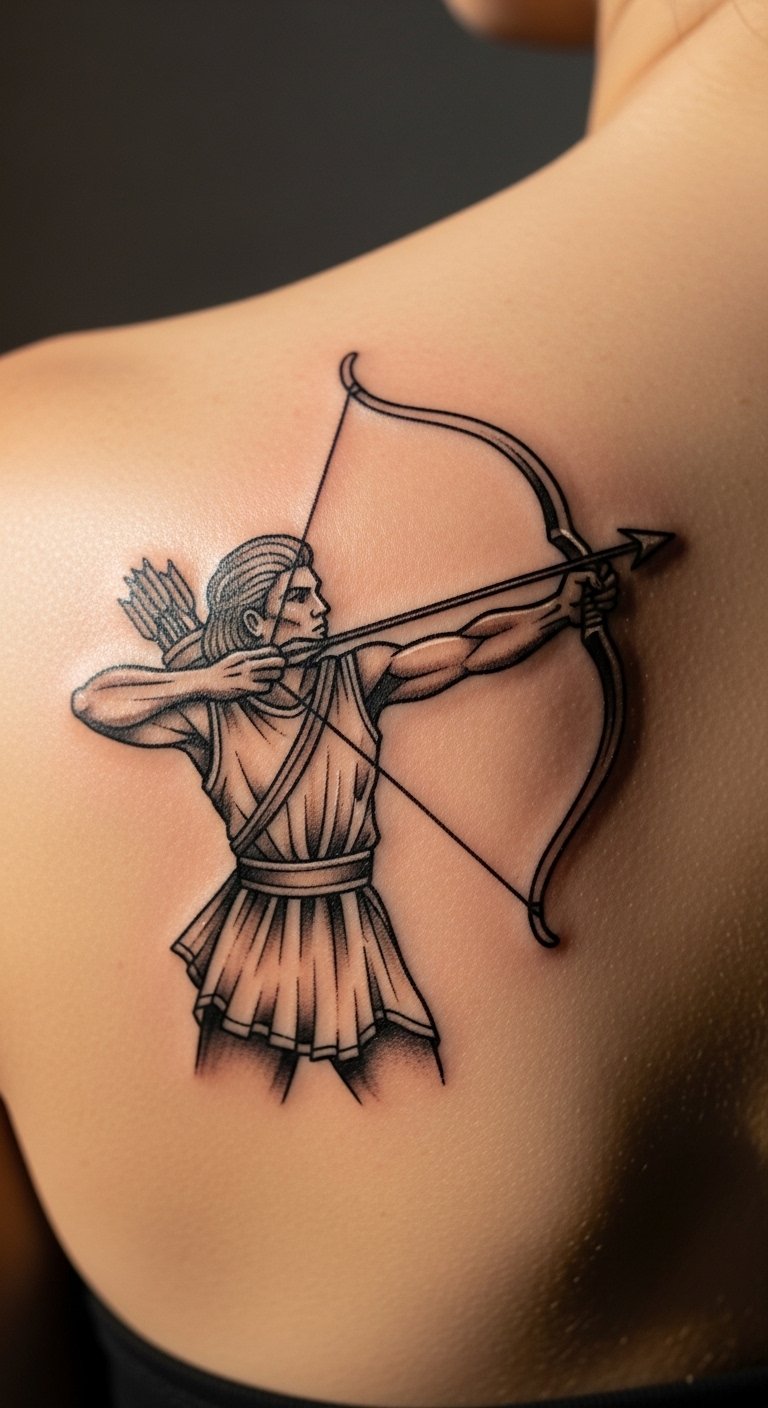
An archer across the shoulder blade has an athletic, directional feel. The shoulder blade is a forgiving surface that hides well under shirts. Traditional or illustrative lines keep the figure readable for years; overly thin limbs blur. Pain is moderate—sharp when over bone but otherwise tolerable. Artists who balance bold outlines with selective color—or stick to confident black—make the piece endure. Avoid extreme foreshortening that looks odd when standing; a slightly stylized archer reads best. Related: traditional, illustrative, zodiac animal.
Capricorn Sea-Goat Calf Portrait
Style/Technique: Fine Line / Dotwork
Pain Level: Medium (3-5/10)
Session Time: 1–3 hours
Best For: Vertical portraits and mythic imagery
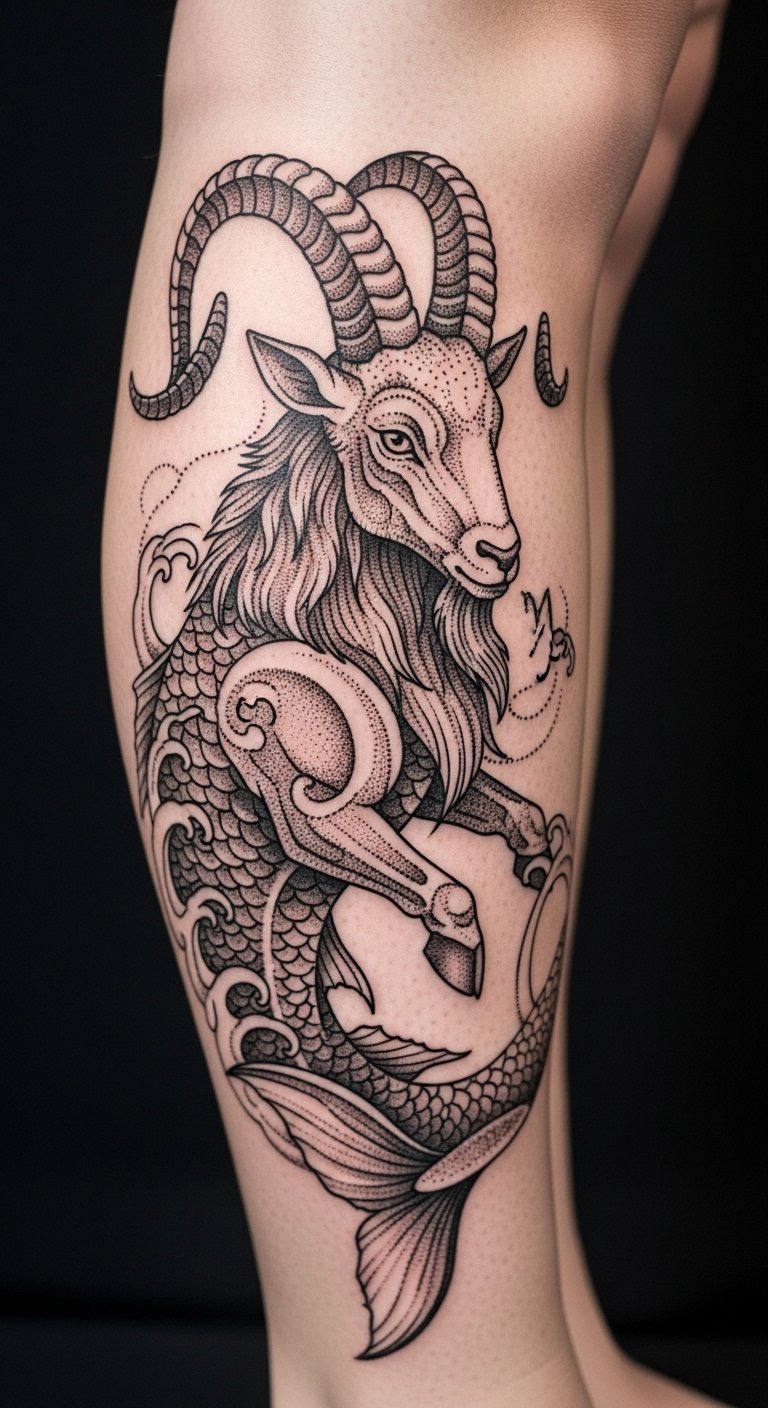
A sea‑goat feels mythic and looks stunning running down the calf. Calf skin tolerates longer sessions and shows detail well. Fine-line horns with dotwork scales create texture; keep contrast between creature and negative space so the silhouette remains strong as ink softens. Calf sessions are usually comfortable with breaks. Don’t cram tiny scales everywhere—strategic dotwork reads better long term. Related: dotwork, fine line, mythic.
Aquarius Water‑Bearer Forearm Scene
Style/Technique: Illustrative / Watercolor Accents
Pain Level: Medium (4/6)
Session Time: 2–4 hours
Best For: Narrative tattoos that flow with arm movement
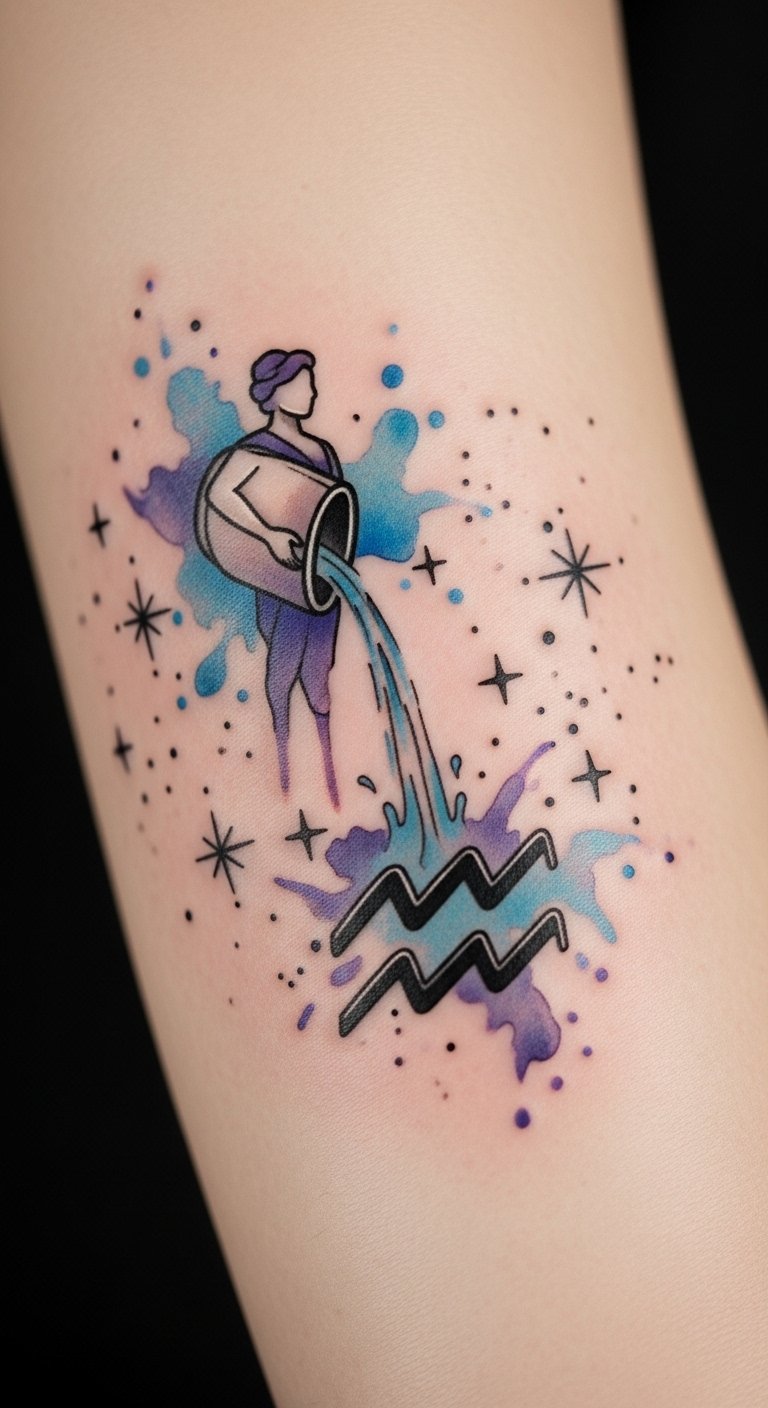
Aquarius imagery loves movement—the forearm lets the water “flow” when you move. Artists combine illustrative figures with watercolor washes for an ethereal look; add fine-line stars for longevity. Forearm heals quickly but sees sun and friction, so waterproof clothing and sunscreen will protect color. Common error: relying entirely on pale watercolor; anchor the piece with black lines or denser color patches that age better. This feels dynamic and readable when healed. Related: watercolor, illustrative, constellation.
Pisces Dual Fish Ankle Loop
Style/Technique: Micro‑Realism / Fine Line
Pain Level: High (6-7/10)
Session Time: 1–2 hours
Best For: Small, looped designs that sit around the ankle

Ankle fish looping into a yin-yang style is poetic, but ankles are bony and sting. Expect longer aftercare due to shoes rubbing. Micro‑realism captures scale and flow, but tiny detail can smear if placed right on the bone—ask for slightly bolder outlines. The loop composition plays well with anklets and looks elegant healed. A key tip: wear soft, open shoes while healing when possible. Related: micro-realism, yin-yang, fine line.
Sunflower Sun Upper Arm
Style/Technique: Neo‑Traditional / Color
Pain Level: Low-Medium (3-4/10)
Session Time: 1–3 hours
Best For: Bright, warm symbolism that reads from afar

I’ve seen sun motifs paired with botanical imagery and they translate astrology into something grounded. Upper arm is an ideal canvas with low-to-moderate pain and great aging characteristics. Neo‑traditional color keeps the warmth without depending on fragile pastels. Common mistake: using pale yellows without contrast; artists recommend rich pigments and black outlines to preserve shape. This reads as joyful and symbolic long after healing. Related: neo-traditional, sun symbol, botanical.
Moonlit Florals Inner Forearm
Style/Technique: Fine Line / Micro‑Realism
Pain Level: Medium (3-5/10)
Session Time: 1–2 hours
Best For: Feminine, readable daily pieces
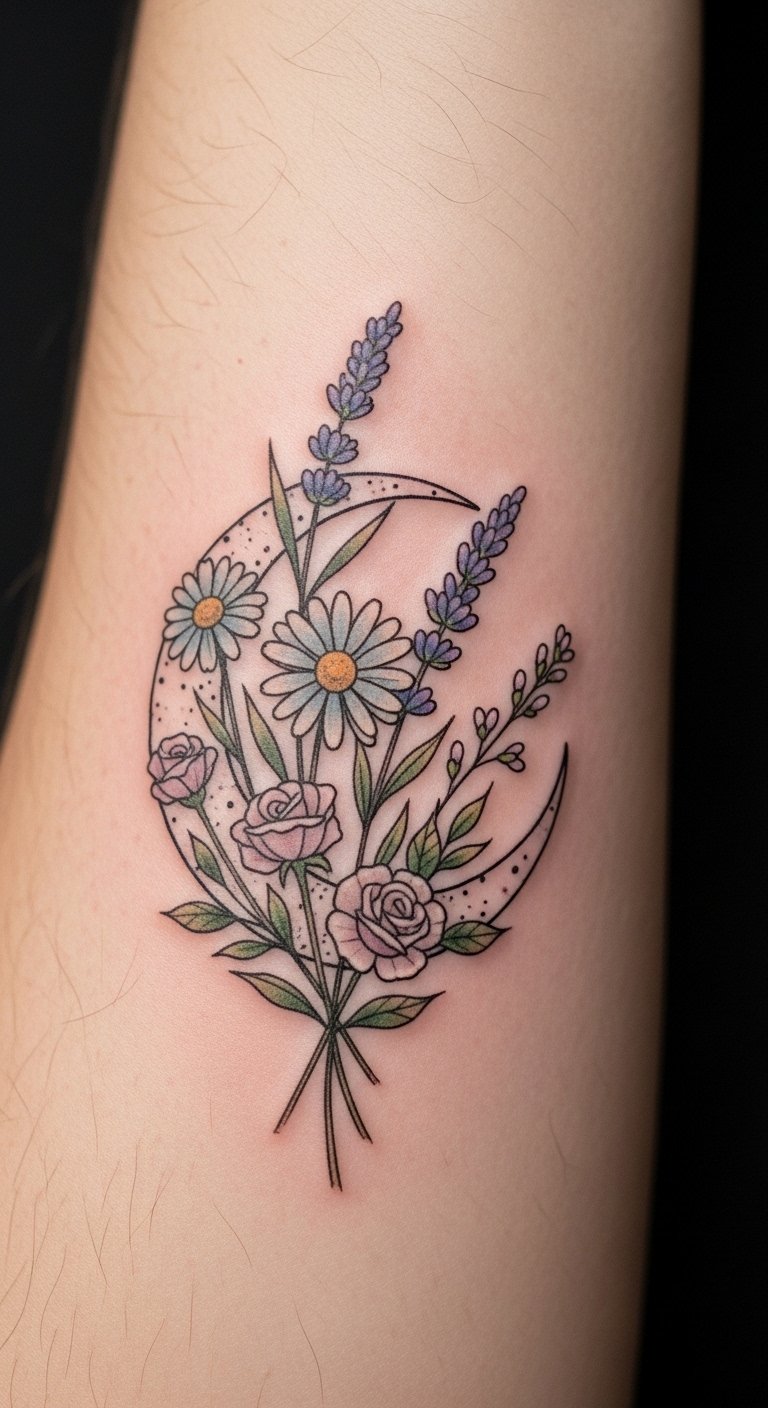
Combining lunar motifs with florals softens astrological imagery into wearable art. Inner forearm placement gives visibility and lower pain; lines settle predictably there. Micro‑realism for petals and fine-line crescent work well together—avoid fussing too many tiny veins that blur. The inner forearm sees sun exposure, so long-term sunscreen is essential to keep contrast. I recommend asking for slightly denser linework in shaded floral areas to prevent early fading. Related: fine line, floral, lunar.
Retrograde Arrow Behind Ear
Style/Technique: Minimalist / Single Needle
Pain Level: Low (2-4/10)
Session Time: 15–30 minutes
Best For: Tiny reminders and conversation starters
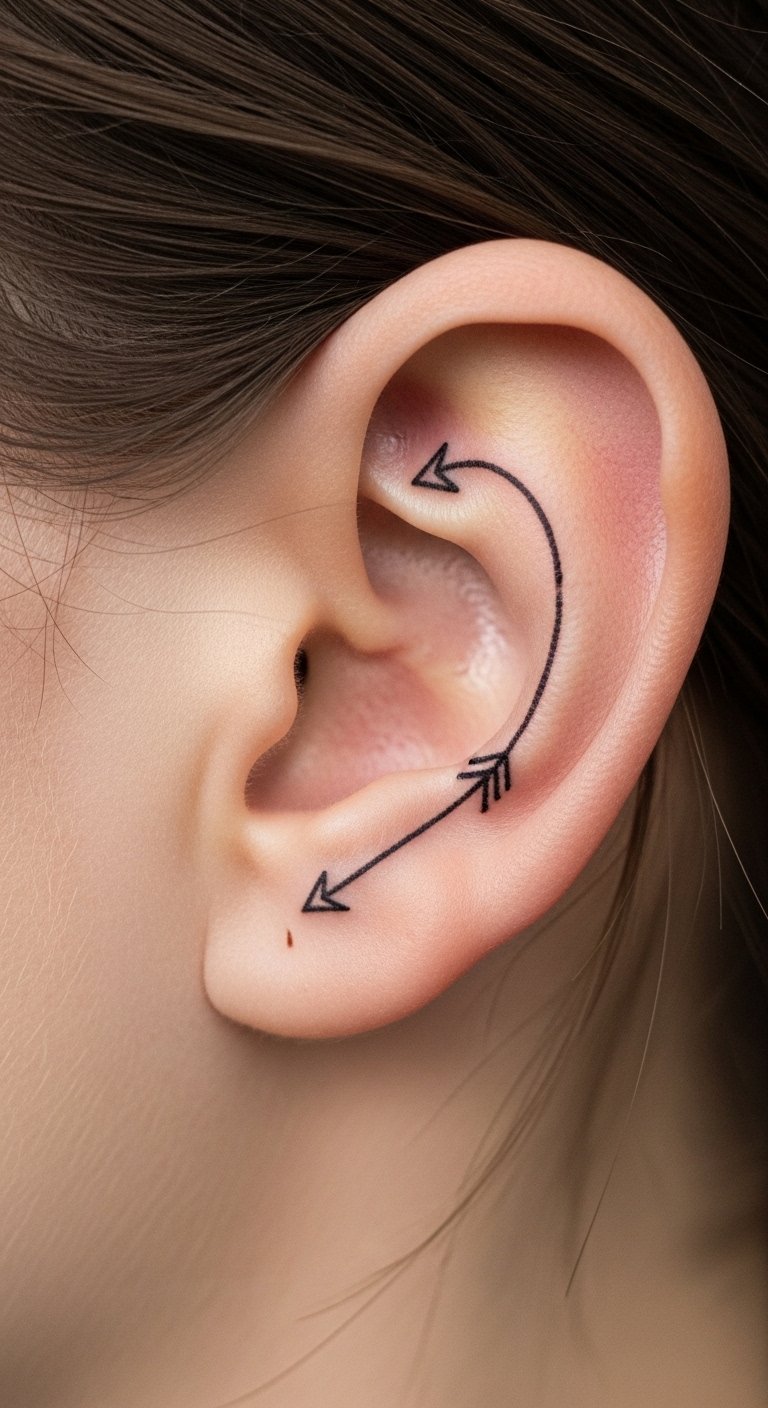
Retrograde arrows are a cheeky, private nod to astrology. Behind-ear placement is discreet and quick to heal but can sting due to thin skin. Single-needle minimalist work must be sized appropriately—too tiny and it will blur into a smudge. I’ve seen this become a favorite "insider" piece for people who love subtle meaning. Related: minimalist, single-needle, glyph.
Planetary Line Across Sternum
Style/Technique: Fine Line / Dotwork
Pain Level: High (7–8/10)
Session Time: 1–2 hours
Best For: Symmetric chest pieces that align with the breastbone
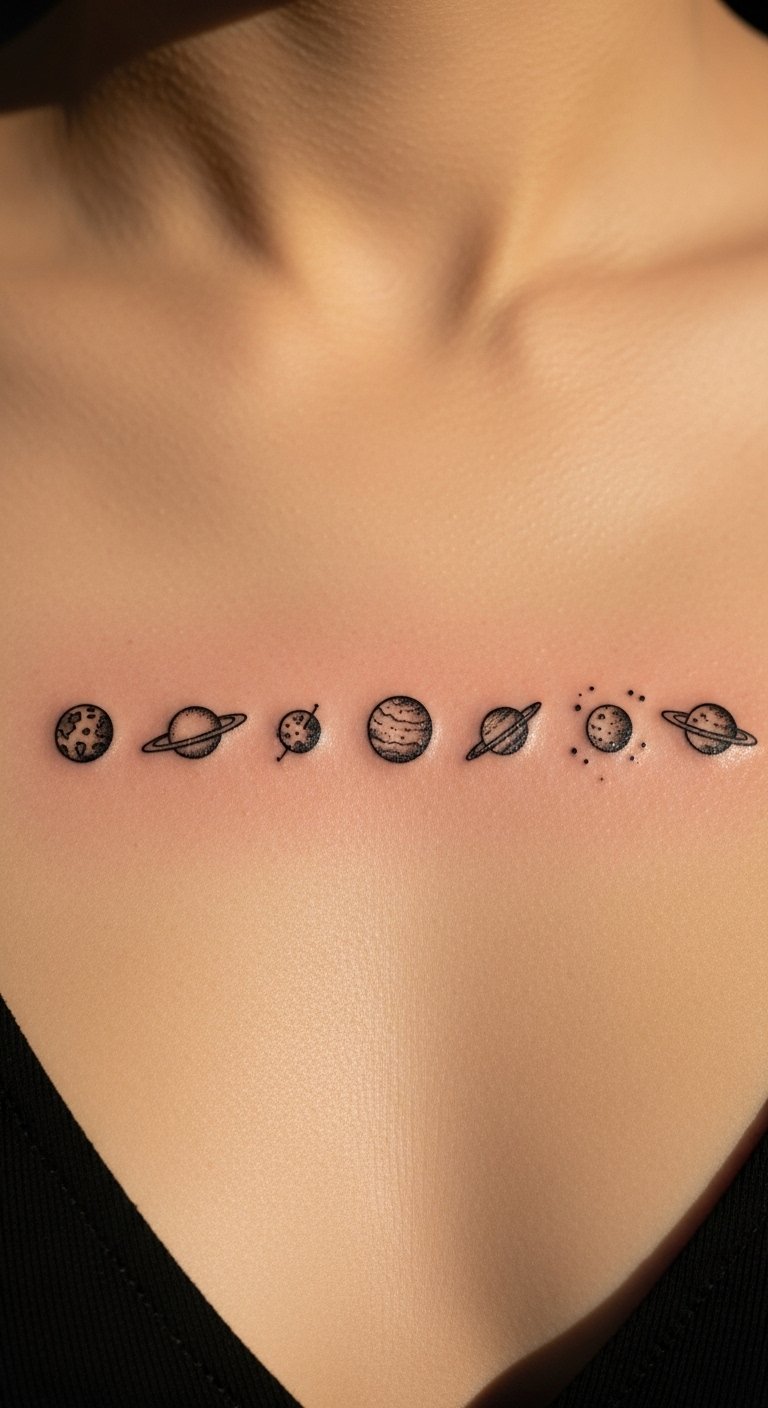
A horizontal planetary line across the sternum reads like a personal constellation necklace. Pain is higher on the sternum, but the visual reward is strong. Keep icons slightly larger than you expect so they stay legible; dotwork can give them texture without clogging. Watch for symmetry—stencils should be checked multiple times with you upright. Related: planetary, fine line, dotwork.
Zodiac Mandala On Sternum
Style/Technique: Geometric / Blackwork
Pain Level: High (7–9/10)
Session Time: Multiple sessions, 2–5 hours total
Best For: Centralized, spiritual centerpieces
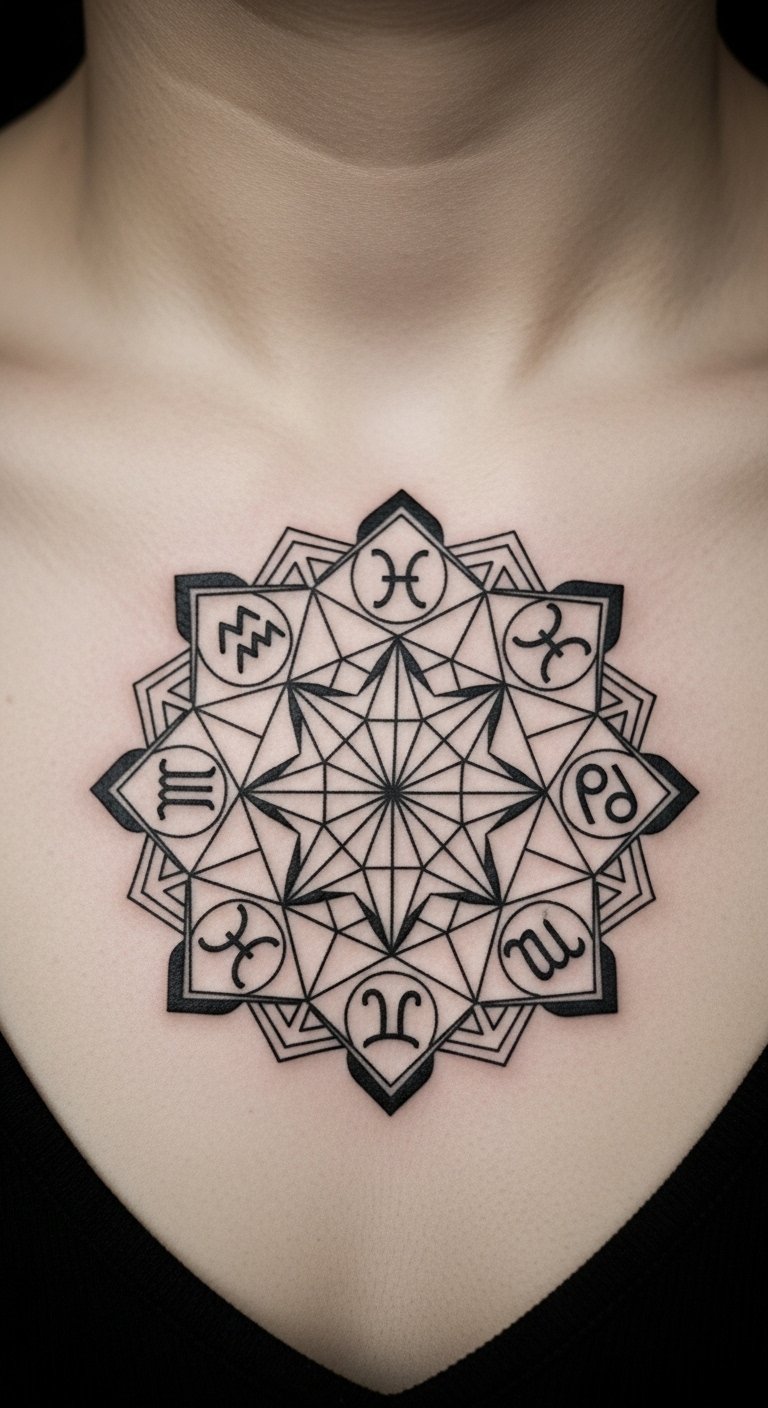
A zodiac mandala centered on the sternum reads like a compact cosmos. Geometric precision matters; choose an artist known for symmetry. Sternum pain is intense near bone but manageable in stages. Blackwork holds up well; keep filigree minimal to avoid future muddiness. A common misstep is over-detailing the inner rings—simpler divisions with clear glyphs age better. Related: mandala, blackwork, zodiac.
Minimalist Star Cluster Finger Band
Style/Technique: Minimalist / Micro Dots
Pain Level: Medium-High (5-7/10)
Session Time: 30–60 minutes
Best For: Tiny, stackable rings and band-style tattoos
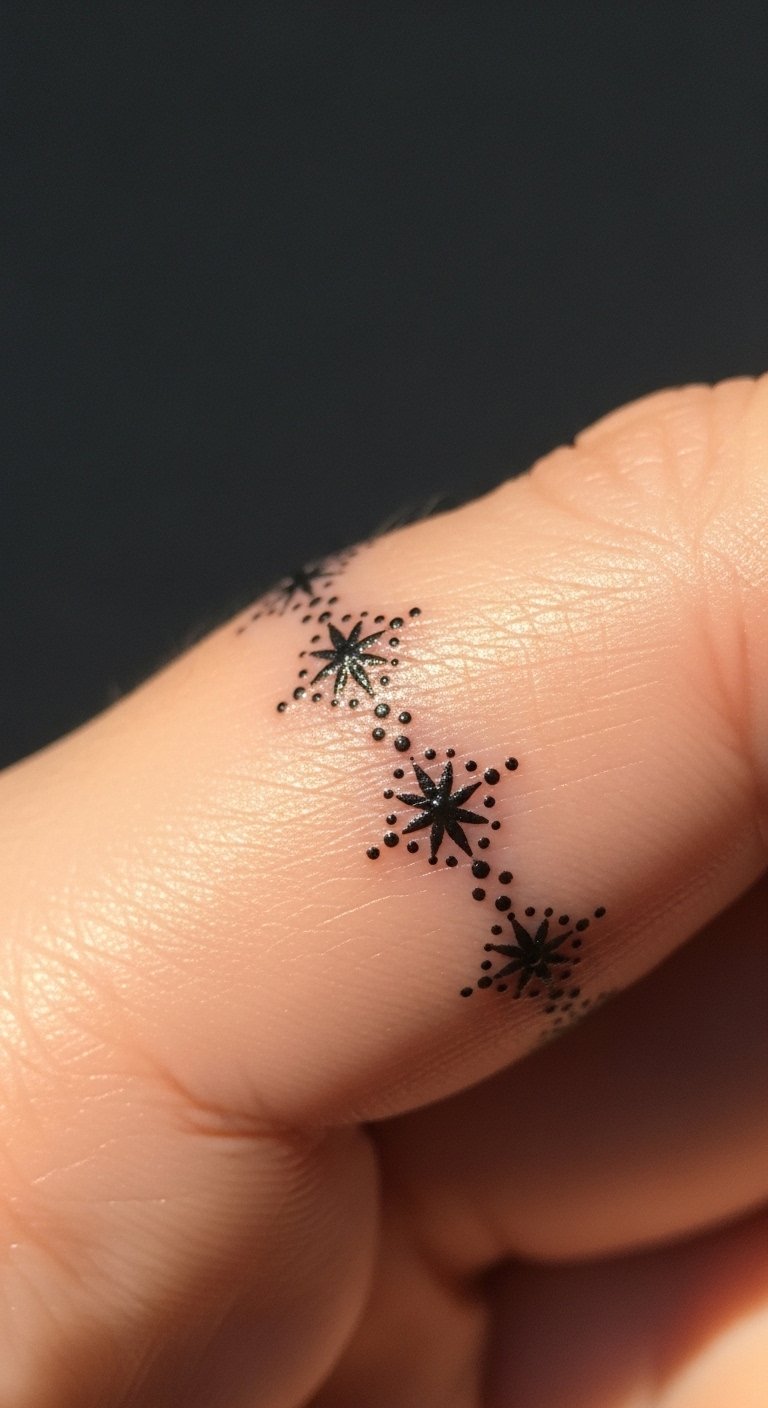
Finger bands are intimate but fade faster due to frequent washing and movement. Micro-dot stars look delicate initially, but plan for touch-ups down the road; artists often recommend bolder dots or spacing to extend life. Fingers hurt more than expected because skin is thin—expect soreness and quick scabbing. If you want a band that lasts longer, consider subtle negative-space designs against a thicker line. Related: micro dots, minimalist, finger tattoo.
Astrological House Glyphs Inner Bicep
Style/Technique: Minimalist / Fine Line
Pain Level: Low-Medium (3-4/10)
Session Time: 30–90 minutes
Best For: Personalized sets, easy to hide or show

House glyphs on the inner bicep are private and meaningful—great if your placements matter more than your sun sign. The inner bicep is forgiving for healing, but motion can tug at fresh ink, so take it easy during the first week. Use slightly bolder line work for glyphs to stay legible. A common misstep is getting too many glyphs crammed together; prioritize the ones that carry the story you want. Related: house glyphs, personalized, fine line.
Rising Sign Behind Nape
Style/Technique: Minimalist / Single Needle
Pain Level: Medium (4-5/10)
Session Time: 20–45 minutes
Best For: Discreet placements that peek through hair

A rising-sign glyph at the nape is quietly visible when hair is up. The area is tetchy but not extreme in pain. Single-needle simplicity reads as a subtle signature of identity. Pick a glyph size that’s seen at arm’s length; too tiny and it becomes a smudge. Aftercare includes being cautious with shampoo and conditioners until the scab falls off. Related: rising sign, single-needle, minimalist.
Stellium Cluster On Upper Thigh
Style/Technique: Fine Line / Dotwork
Pain Level: Low-Medium (3-5/10)
Session Time: 1–3 hours
Best For: Personal, coverable astrology that stays private
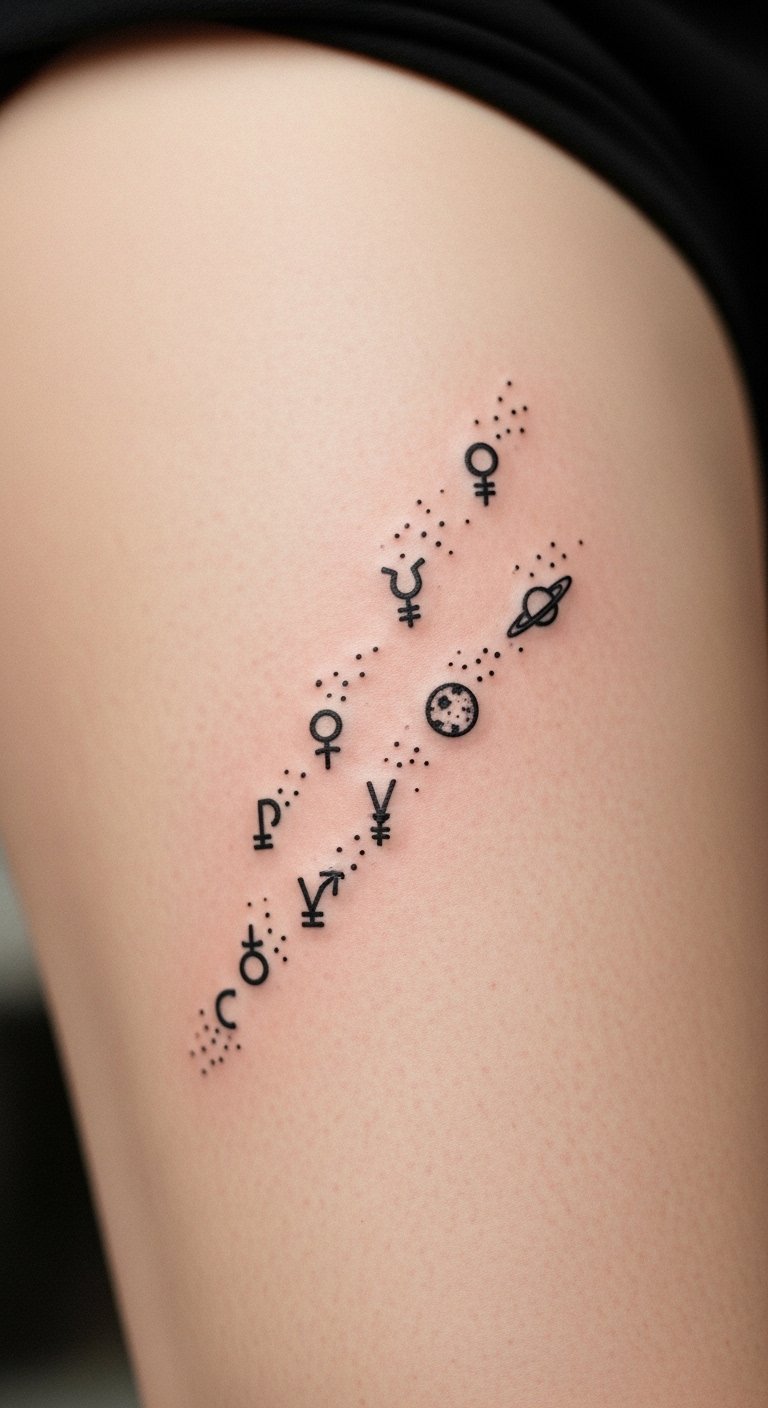
A stellium cluster groups relevant planets in one compact piece; the thigh gives privacy and room to play with scale. Thigh skin heals well with low visibility to sun when covered. Dotwork connectors can make it feel celestial without crowding. Avoid tiny script among the planets; leg movement and skin texture can distort fine text over time. Related: stellium, dotwork, fine line.
Comet Tail Back Of Shoulder
Style/Technique: Illustrative / Fine Line
Pain Level: Medium (4/5/10)
Session Time: 1–2 hours
Best For: Dynamic, directional tattoos that work with movement
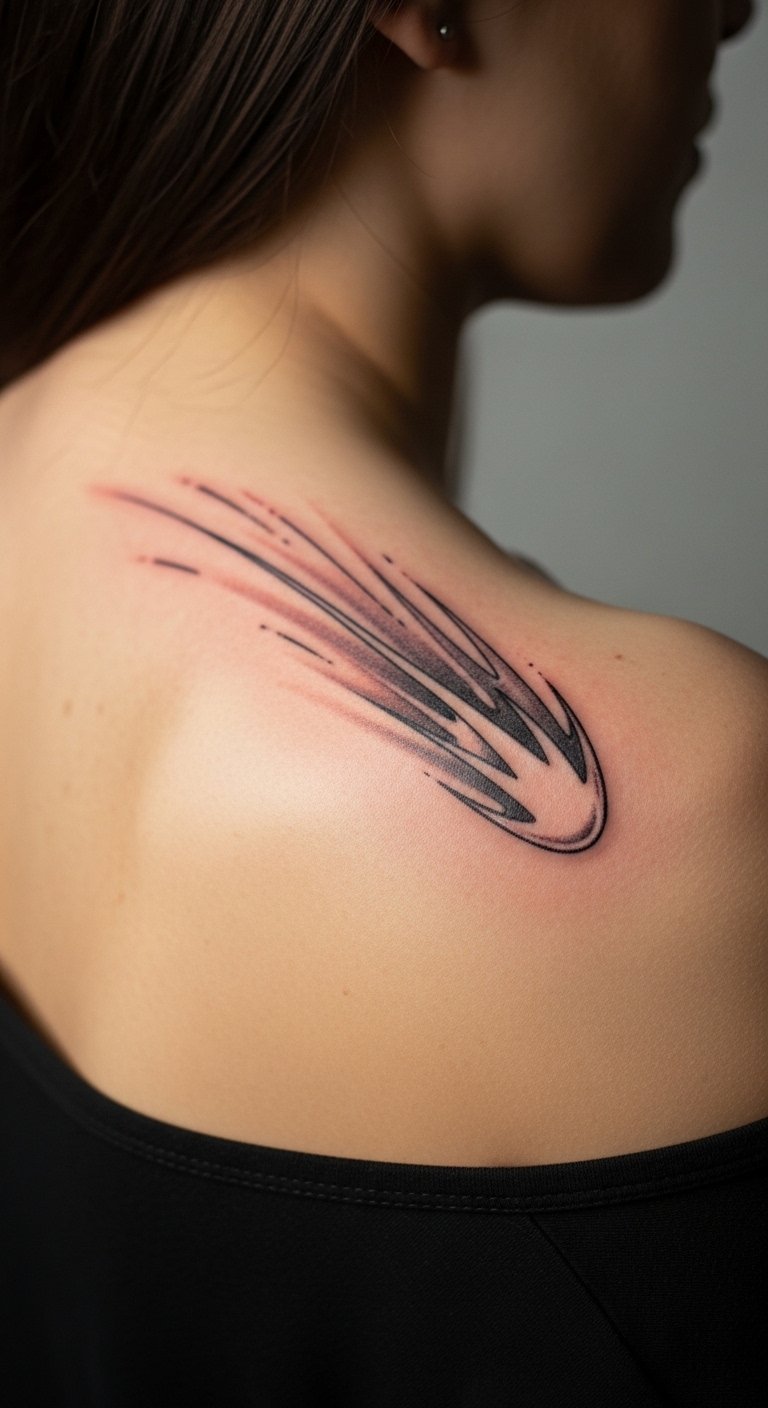
Comet tails accentuate shoulder lines and look great peeking from a strap top. The back of shoulder is forgiving and a smart place for movement-based designs. Keep tail lines slightly bolder so they don’t feather; artists often add small stars or dotwork to anchor the motion. Healing is straightforward with minimal friction. Related: comet, movement, illustrative.
Natal Coordinates Inner Wrist
Style/Technique: Minimalist / Fine Line
Pain Level: Low (2-3/10)
Session Time: 20–45 minutes
Best For: Subtle personalization—coordinates tied to birth
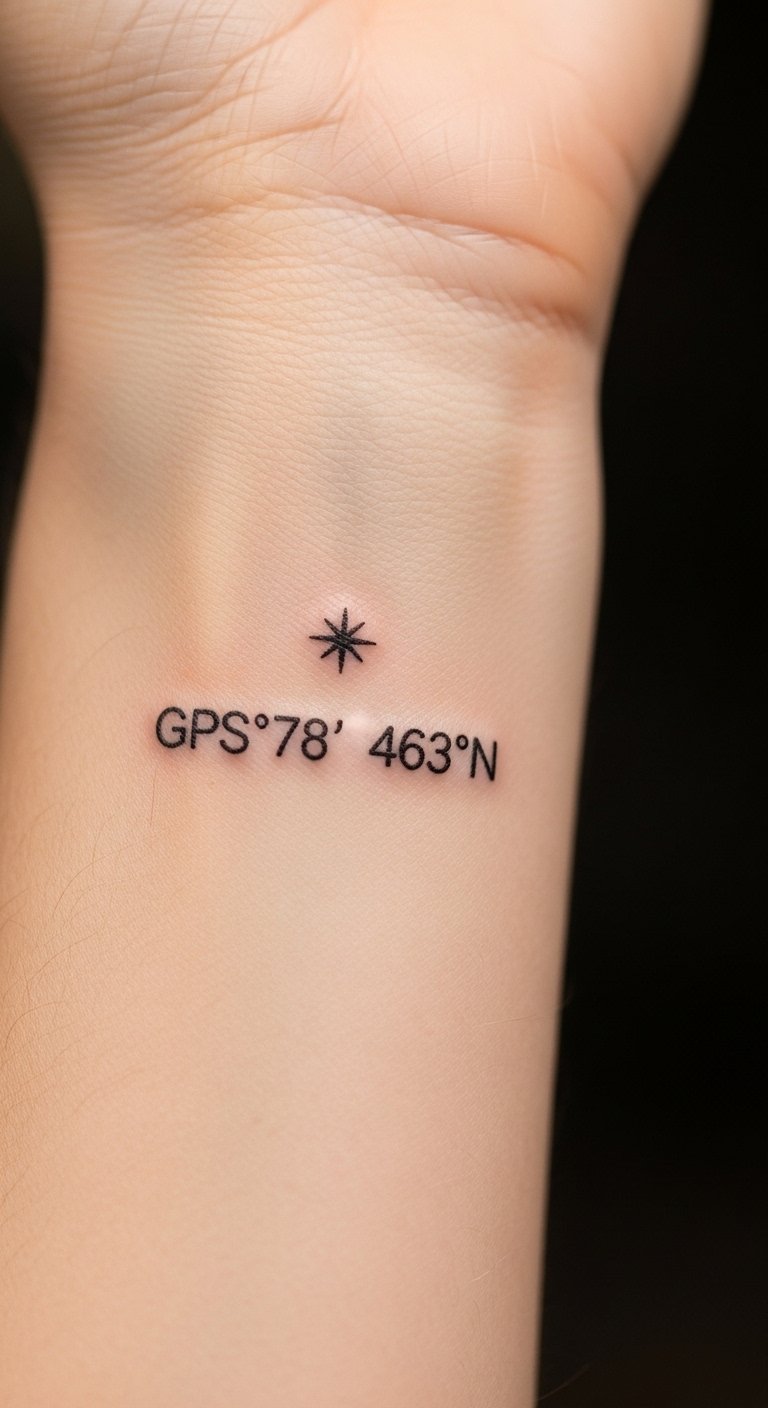
Coordinates tattooed with a tiny star are quiet and intimate reminders of origin. Inner wrist heals quickly but is exposed—use sunscreen long-term. Make sure numerals are bold enough to avoid merging; ask your artist for slightly heavier numerals at small sizes. It’s a great option for people who want astrology tied to place. Related: coordinates, minimalist, personal.
Horoscope Constellation Ankle Bracelet
Style/Technique: Fine Line / Dotwork
Pain Level: Medium (4-6/10)
Session Time: 1–2 hours
Best For: Delicate wrap tattoos that resemble jewelry
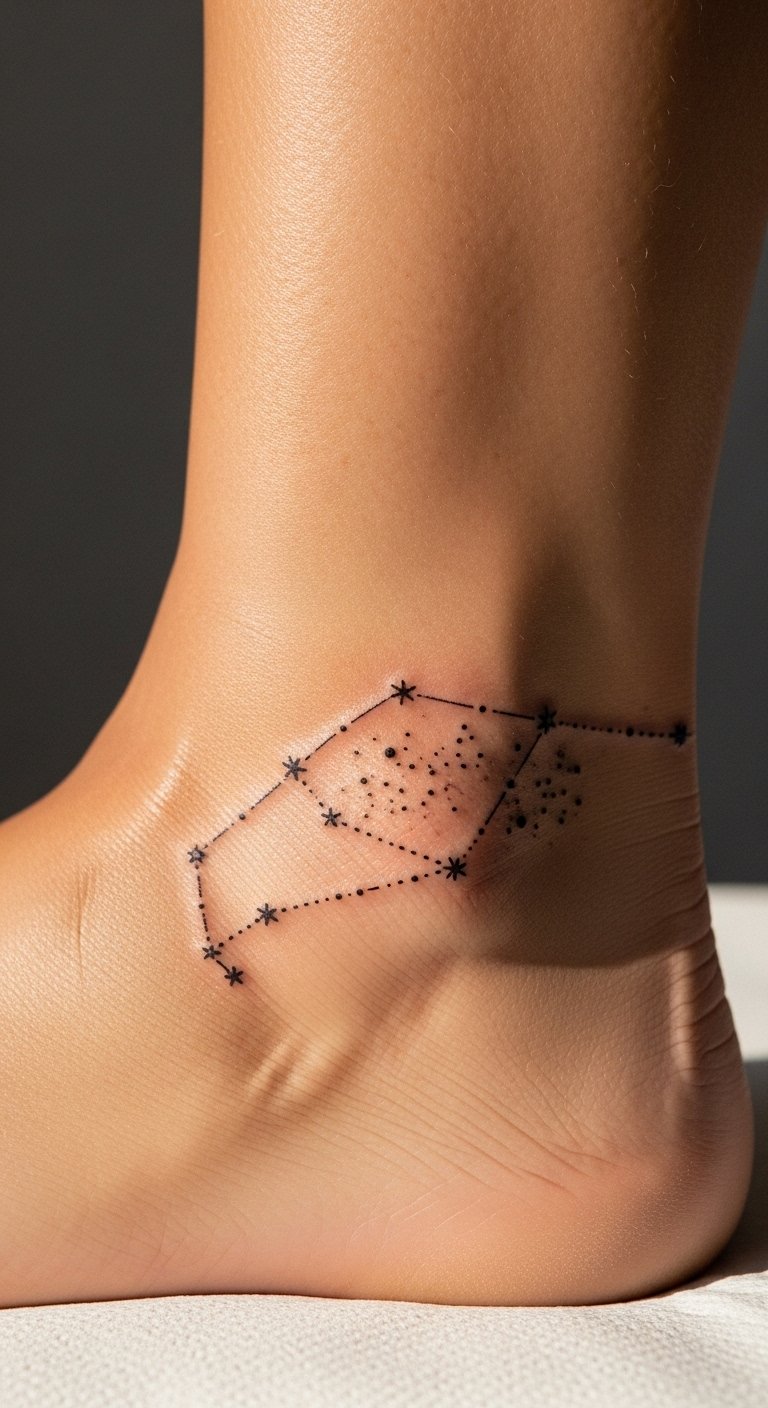
An ankle constellation band works like jewelry and moves with you. Ankle pain can spike near bone; boots and shoes may irritate while healing, so plan footwear wisely. Ask for slightly larger star dots and clean spacing. Overly faint lines around the ankle blur fast—artists suggest reinforcing the design with tiny anchor dots. Related: ankle bracelet, constellation, dotwork.
Planetary Sigils On Fingers
Style/Technique: Minimalist / Single Needle
Pain Level: High (6-8/10)
Session Time: 20–60 minutes
Best For: Tiny symbolic accents and stackable ideas
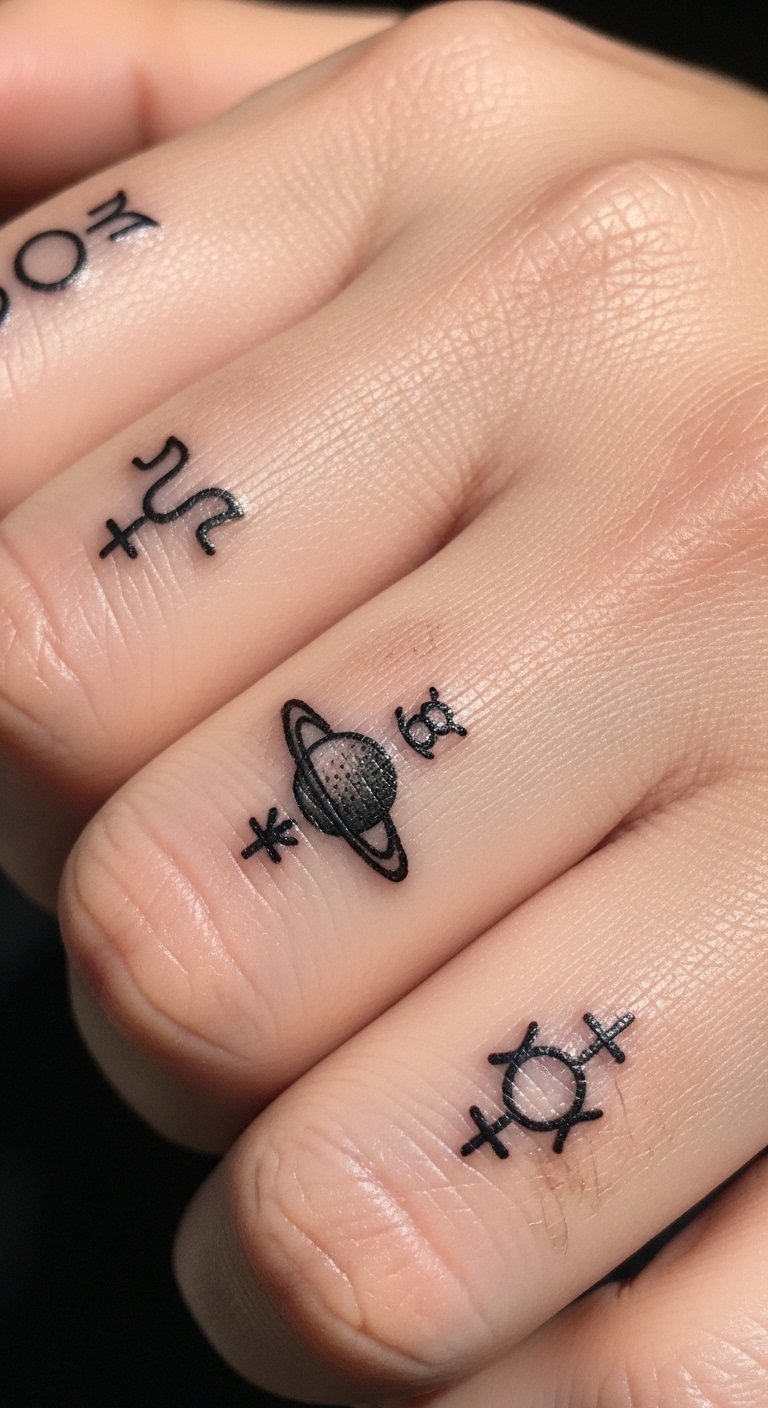
Finger tattoos are visible and meaningful but notorious for faster fading. Planetary sigils look sleek across fingers, but be ready for touch-ups—skin on fingers renews frequently. Pain is sharper on fingers, and healing requires gentle hand care. Artists often recommend thicker line weight or negative-space fills to extend life. If you want a long-lasting finger piece, prioritize boldness over ultra-thin detail. Related: finger tattoo, planetary, minimalist.
Zodiac Constellation Backpiece (Partial)
Style/Technique: Blackwork / Fine Line
Pain Level: Medium (5/7/10)
Session Time: Multiple sessions, 3–6+ hours
Best For: Large, personalized back art with multiple signs represented
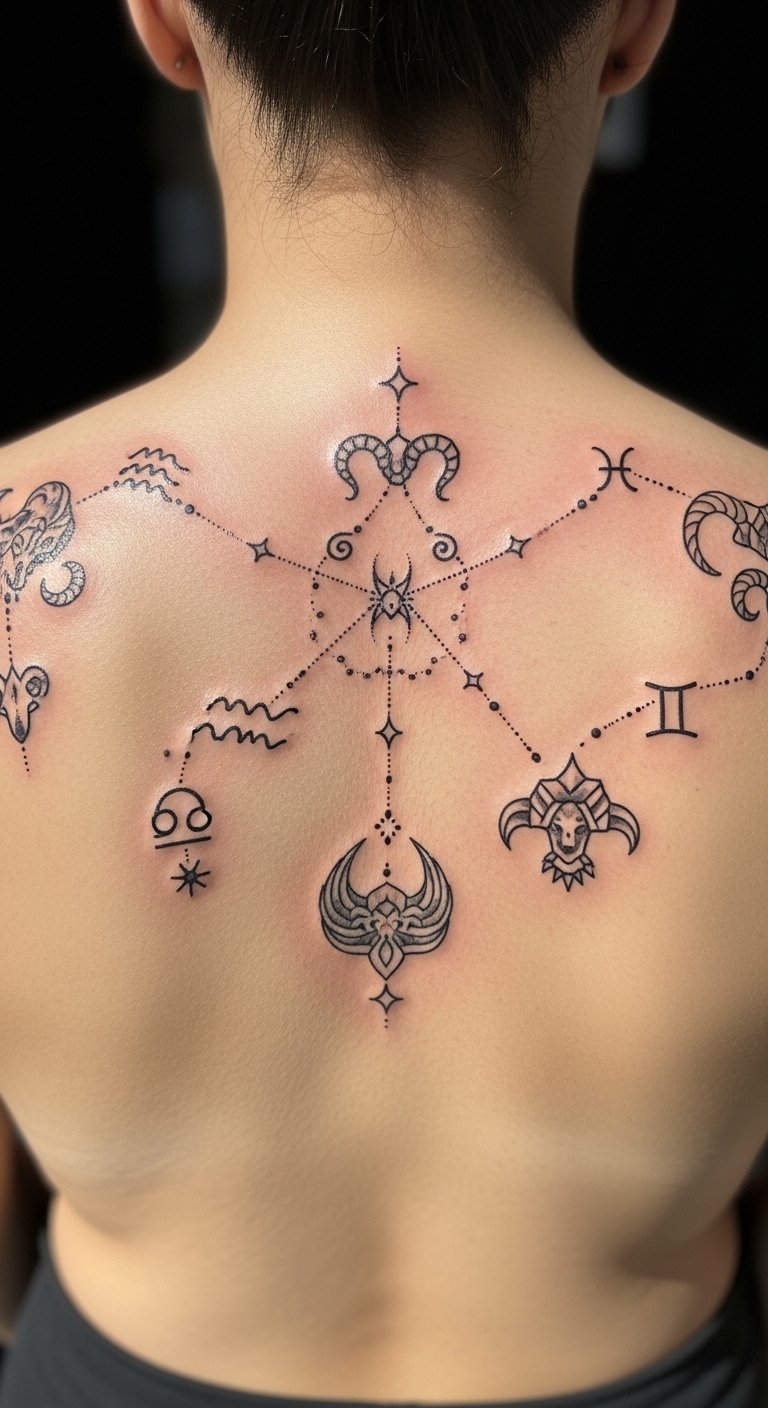
A backpiece can map multiple constellations into a coherent night-sky scene. The back’s large canvas allows for spacing that prevents blurring. Expect several sessions and staged healing. Blackwork anchors constellations and prevents early loss of detail, while fine-line stars add delicacy. Don’t try to fit every tiny star; choose the ones that read most strongly. Related: backpiece, blackwork, constellation.
Planetary Conjunction Finger Line
Style/Technique: Minimalist / Single Needle
Pain Level: High (6-8/10)
Session Time: 15–45 minutes
Best For: Micro tattoos emphasizing alignment and conjunctions

Conjunction lines on fingers are precise and meaningful but face the same longevity issues as other finger work. If you choose this, plan for denser dots rather than hairline dots. Pain is noticeable, but sessions are short. Keep expectations realistic about future touch-ups. Related: planetary conjunction, minimalist, finger tattoo.
Zodiac Wheel Forearm Band
Style/Technique: Geometric / Fine Line
Pain Level: Medium (4–6/10)
Session Time: 1–3 hours
Best For: Visible, circular bands that wrap the forearm

A forearm zodiac band is graphic and wearable. Make sure glyphs aren’t jammed—spacing is critical so each sign stays legible as lines soften. Forearms tolerate longer sessions and sunlight exposure, so sunscreen is important. Artists who excel in clean geometric lines are best. Related: zodiac wheel, geometric, forearm band.
Tattoo Prep and Aftercare Essentials
Aftercare (healing):
- Aquaphor Healing Ointment, 14oz tube — Great for the first 3–5 days when skin is most raw.
- Saniderm Transparent Adhesive Bandage, 6-inch roll — Second-skin option to reduce scabbing and friction.
- Dr. Bronner's Unscented Castile Soap, 32oz — Gentle cleanser for the first week.
- CeraVe Fragrance-Free Moisturizing Lotion, 12oz — Lightweight, non-irritating daily moisturizer for days 4–30.
Before appointment / pain management:
- Tattoo Numbing Cream 5% Lidocaine — Use only if your artist approves and follow instructions.
- Tattoo Stencil Transfer Paper — Handy if you’re working through composition at home first.
Long-term maintenance:
- SPF 50 Sunscreen Stick (travel) — Daily sunscreen is the best protection against fading.
- Mad Rabbit Tattoo Balm, 2oz — Popular for healed tattoo maintenance.
- Hustle Butter Deluxe, 8oz — Vegan aftercare balm used by many artists.
- Hydrocolloid Bandages (large) — For small open spots or protective coverage during workouts.
Optional comfort items:
- Tattoo Aftercare Kit (multi-piece) — Handy for first-timers who want everything in one kit.
Frequently Asked Questions
Q: How bad does a tattoo actually hurt?
A: Pain depends on placement and your tolerance. Outer forearm/upper arm = lower pain (2–4/10). Ribs, sternum, and inner ankle tend to be higher (7–9/10). It’s more a steady burn or scratching than sharp surgical pain. For sensitive spots, ask about tattoo numbing cream 5% lidocaine—but consult your artist first.
Q: What if I regret my tattoo?
A: Sit with designs for months and pick placements you can cover if needed. Start with small, meaningful glyphs if you’re unsure. Laser removal exists but is a long process; consider hiding placements when in doubt.
Q: How do I keep my tattoo from fading?
A: Sunscreen is essential. Use a high-SPF stick like SPF 50 sunscreen stick daily and moisturize with a fragrance-free lotion such as CeraVe.
Q: Can I work out after getting a tattoo?
A: Wait at least 48–72 hours before intense workouts; longer if the tattoo flexes or chafes. Sweat can irritate fresh ink and introduce infection risk.
Q: Should I get a small tattoo first to test pain?
A: Only if you actually like the small design. Pain varies by placement more than size—tiny tattoos on bony spots can hurt more than larger pieces on fleshy areas.
Q: How long does a tattoo take to heal?
A: Surface healing: 1–3 weeks. Full settling: 2–3 months. First week is critical—clean gently with mild soap and use Aquaphor or recommended ointment. Expect peeling and dullness before brightness returns.
Q: Do tattoos look different on different skin tones?
A: Yes. Black and gray hold well across tones; very pale or fluorescent colors can appear muted on deeper skin. Find artists who share healed examples on your skin tone.
Conclusion
I recommend sketching ideas, sitting with them, and consulting an artist who shows healed examples you like. Protect fresh ink with Saniderm or Aquaphor in the first days, then use SPF for long-term care. Which astrology piece are you most drawn to—a tiny glyph or a mapped birth sky?